

GCRD and UNITAR to Convene Global Dialogue on AI, Social Justice, and Democratic Trust
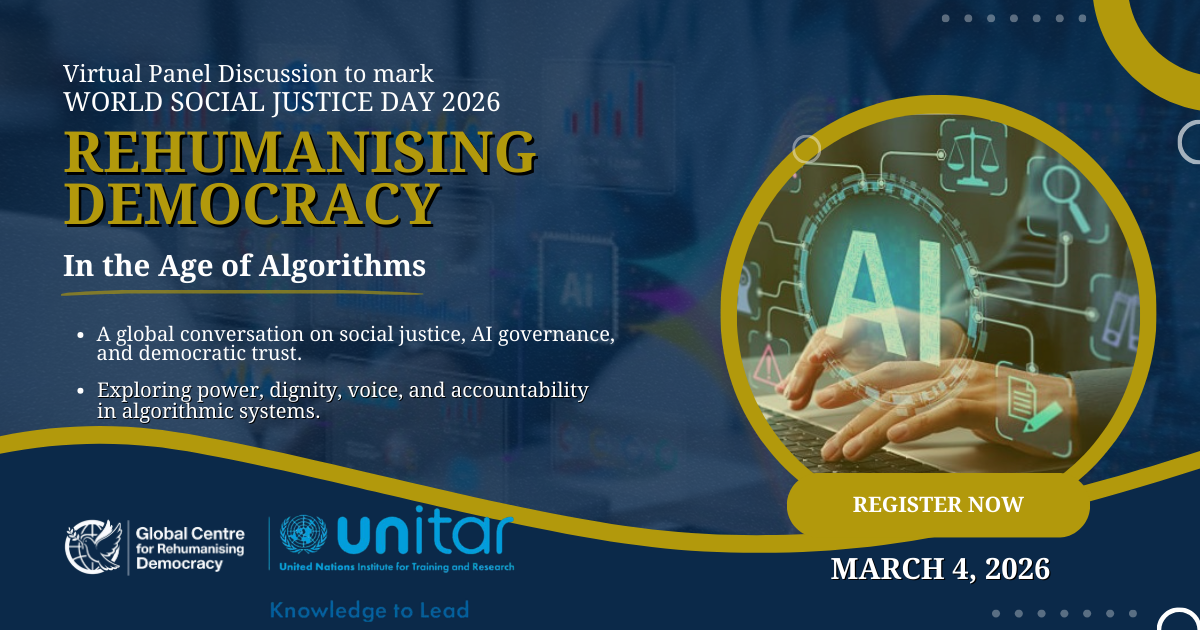
To mark World Social Justice Day 2026, the Global Centre for Rehumanising Democracy (GCRD), in collaboration with the United Nations Institute for Training and Research (UNITAR), will convene a high-level virtual panel discussion to examine the growing impact of artificial intelligence on social justice, democratic trust, and the future of work. The event will hold virtually on March 4th at 4 - 5 pm GMT.
Titled Rehumanising Democracy in the Age of Algorithms: Social Justice, AI, and Democratic Trust, the event will bring together experts from governance, artificial intelligence, media and gender studies, and youth leadership to explore how algorithmic systems increasingly shape access to employment, public services, information, and civic participation, and how they reproduce and amplify existing inequalities.
The panel will feature Dr. Jon-Hans Coetzer, Senior Programme Specialist at UNITAR, who will address the implications of AI governance for institutional trust, peacebuilding, and just transitions, particularly in contexts marked by inequality and fragility. His contribution will highlight the importance of capacity-building and ethical leadership in helping public institutions navigate technological change responsibly.
From a technical perspective, Dr. Nicholas Mattei, Associate Professor of Computer Science at Tulane University, will examine how algorithmic decision-making systems influence individual and collective choices. He will explore why claims of algorithmic neutrality often obscure embedded values and power asymmetries, and why transparency and accountability are essential to democratic legitimacy.
Professor Wajiha Raza Rizvi will bring a critical media and gender lens to the discussion, drawing on decades of research into representation, power, and geopolitical inequality. Her intervention will consider how algorithmic systems extend older patterns of exclusion into new digital forms, particularly affecting women and marginalised communities in the Global South.
Foregrounding youth perspectives and the future of jobs, Sabene Rizvi, a Youth Organizing Fellow and senior at Purdue University Fort Wayne, will reflect on how AI-driven systems shape employment pathways, democratic access, and participation for younger generations. Her contribution will emphasise the importance of including youth voices in shaping the norms and governance structures of emerging technologies.
The discussion, which will be moderated by GCRD board member, Dr. Antonio Garcia, will explore the links between algorithmic justice, institutional trust, and democratic resilience, underscoring that AI governance cannot be treated as a purely technical or regulatory challenge. Instead, it raises fundamental questions about power, accountability, and the future of democratic life.
The event will also offer a preview of themes explored in a forthcoming joint GCRD–UNITAR initiatives. As societies confront rapid technological change alongside deepening social and democratic challenges, the event reflects GCRD’s core commitment to rehumanising democracy, ensuring that digital transformation serves people, dignity, and the common good.
Details of the event and registration details are available at the GCRD events page.
