

Democracy Has a Measurement Problem. This Global University Consortium Is Joining us to Solve It

The Global Centre for Rehumanising Democracy (GCRD) is proud to announce the inaugural cohort of university partners joining the Democracy Discourse Index (DDI) consortium. The DDI is the world's first real-time tool for measuring democratic health through the quality of public discourse. It tracks how people actually argue, empathise, and reason together in public life.
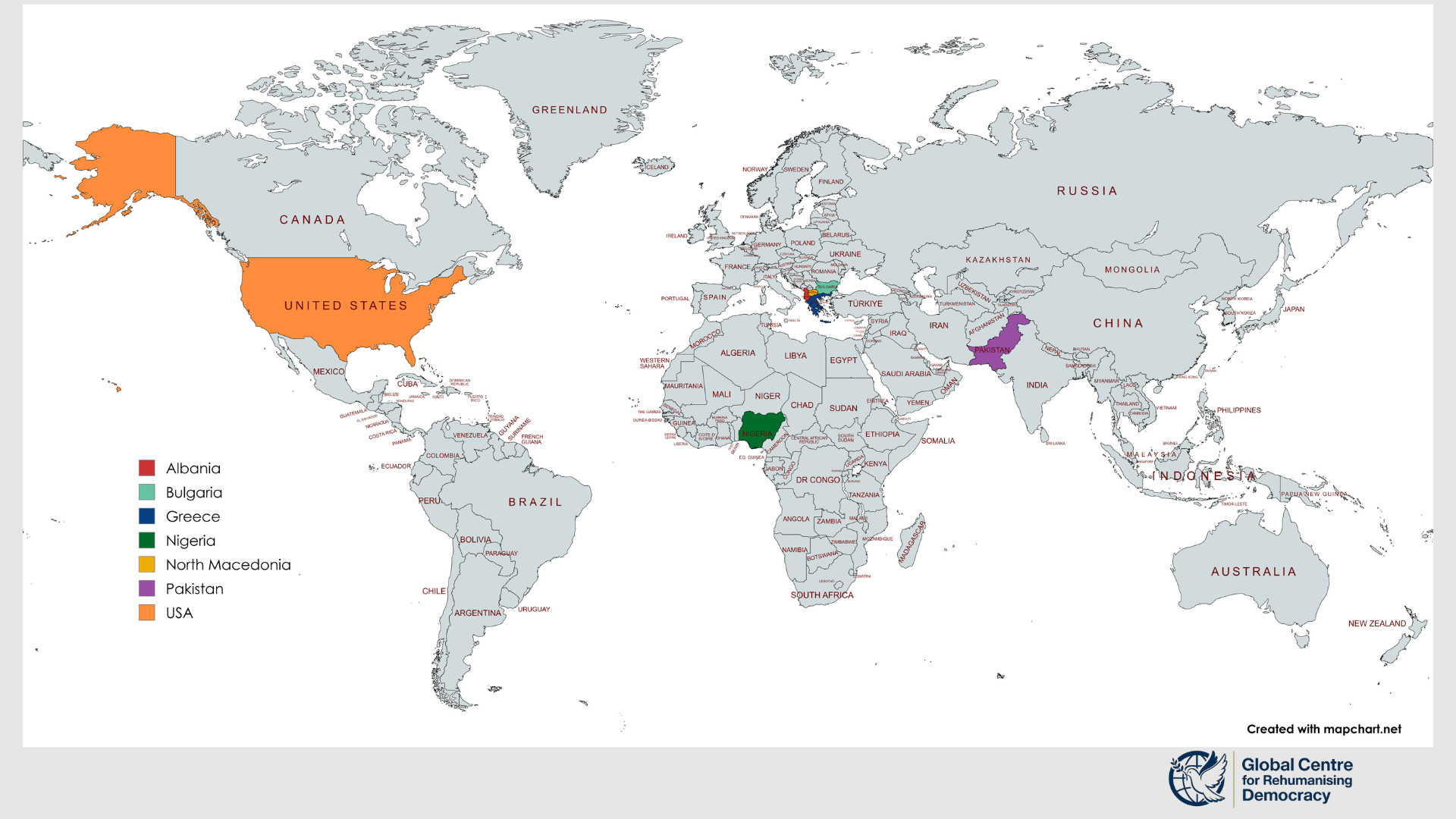
Beginning Spring 2026, faculty and students at seven institutions across Europe, North America, Africa, and Asia will analyse social media discourse using the DDI's six-dimension framework, contributing human-coded data that will train AI classifiers capable of monitoring democratic conversation at scale, in real-time.
The Founding Consortium
Spanning seven countries and a remarkable range of disciplines, the founding partner institutions reflect the DDI's commitment to building a genuinely global index that captures the diversity of democratic experience.
Aristotle University of Thessaloniki, Greece brings one of Europe's most distinguished journalism schools to the consortium. Professor Nikos Panagiotou who heads the Peace Journalism lab and the Digital Communication Network Global, and Dr. Panagiotis Paschalidis in the School of Journalism and Mass Communications, integrates DDI research across courses in Media Literacy, Political Communication, and Strategic Communication, with undergraduate students coding discourse at a moment of acute democratic stress across Southern Europe.
New Bulgarian University, Bulgaria, joins through its Political Science department, where Professor Lyubomir Stefanov will incorporate the DDI into a course in Modern World. Bulgaria's position at the intersection of EU democratic consolidation and sustained disinformation pressure from the East makes it a particularly significant node in the network.
Fan S. Noli University of Korçë (UNIKO), Albania, contributes through Dr. Juliana Çyfeku, whose work spans the Department of Foreign Languages and the Department of Social Sciences. Albanian participation connects the DDI to a country navigating the complex dynamics of EU accession, where public discourse quality has direct implications for democratic trajectory.
Tulane University, United States, enters the consortium through its School of Architecture and Built Environment, where Professor of Practice Verse Shom embeds DDI research within a course on Understanding Complex Systems. Tulane's participation brings a distinctive social innovation lens to discourse analysis across key topics, including climate change. Tulane extends the DDI's reach into the United States, the world's most consequential democratic laboratory.
University of St. Kliment Ohridski Bitola, North Macedonia, joins through its Faculty of Security in Skopje, where Professor Aleksandar Ivano integrates DDI research into a course on Environmental Security. North Macedonia's ongoing democratic consolidation and its exposure to regional disinformation dynamics make its participation analytically vital.
Film Museum Society with NED University of Engineering & Technology, Pakistan contribute through Professor Wajiha Raza Rizvi, whose work on Gender and Media positions Pakistan as a critical partner for understanding how discourse quality intersects with gender, culture, and information access in the Global South.
Federal University of Technology Minna, Nigeria, rounds out the inaugural cohort, with Professor Nicolas Sesugh Iwokwagh of the School of Information and Communication Technology integrating DDI research into a course on Emerging Media. Nigeria, Africa's most populous democracy, brings a continent-wide perspective to discourse measurement and anchors the DDI's African presence.
Why it Matters
The DDI's validity as a global measurement instrument depends on the quality and diversity of its training data. Algorithms trained exclusively on Western, English-language content produce biased results when applied globally. This has been a persistent limitation of existing computational approaches to democratic measurement. By building the corpus through human coders embedded in local cultural and linguistic contexts, GCRD and its university partners are constructing something qualitatively different: a measurement framework that reflects how democracy is actually lived, argued, and contested across radically different societies.
Beginning Spring 2026, faculty-led student research teams at each partner university will analyse social media discourse using the DDI's six-dimension framework, contributing human-coded data that trains AI classifiers capable of monitoring democratic conversation at scale. Classrooms become democracy observatories. Students become researchers contributing to a global scientific instrument. The university teams of human coders will interpret discourse with the nuance no algorithm can fully replicate.
For students, participation offers an extraordinary opportunity. Working directly on live data through the Sensika AI-powered platform, they will develop skills in discourse analysis, comparative research methodology, and AI-assisted content coding, contributing to scholarship that will be published, cited, and used by policymakers and international institutions.
"This consortium represents exactly what democratic research should look like in the twenty-first century," said Dr. Jacob Udo-Udo Jacob, Founding Executive Director of GCRD. "Seven institutions from seven countries, disciplines ranging from journalism and political science to security studies and social innovation, all working together to ask the same fundamental question: what does the quality of public conversation tell us about the health of democracy? The answer, we believe, will change how the world measures and protects democratic life."
What Comes Next
Faculty partners will complete methodology training and platform orientation in the coming weeks, with active DDI corpus development and discourse coding beginning in the Spring 2026 semester. GCRD and Sensika Technologies will provide ongoing technical support, inter-coder reliability protocols, and regular calibration sessions throughout the research period.
The Democracy Discourse Index is a partnership between the Global Centre for Rehumanising Democracy and Sensika Technologies, part of the joint Disinformation Observatory initiative. To enquire about the project and how your university can participate, please contact GCRD at info@gcrd.org.uk.
