

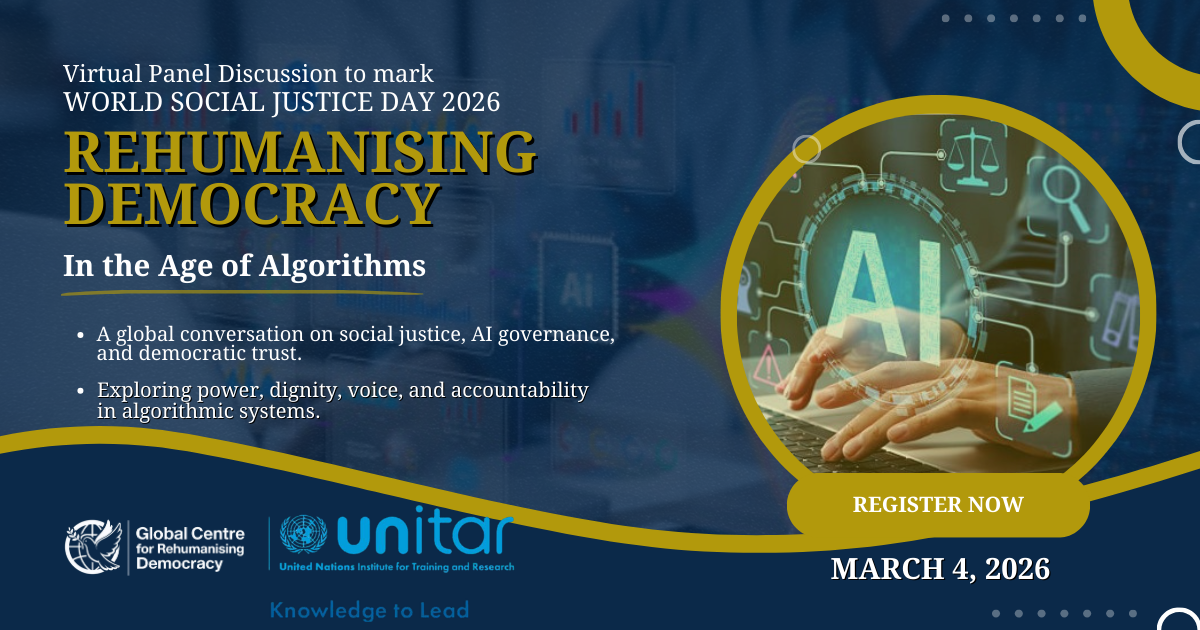
Date: Wednesday, March 4, 2026 | Time: 4 pm - 5 pm (GMT)
Format:Virtual (Zoom)
Registration: Required | Free to attend | Click here to register or cut and paste this link: http://bit.ly/4cTRfn6.
Artificial intelligence and algorithmic systems increasingly shape access to employment, welfare, healthcare, information, and civic participation. While often presented as neutral or efficiency-enhancing, these systems can reproduce and amplify existing inequalities, raising urgent questions of social justice, democratic accountability, and institutional trust. Marking World Social Justice Day 2026, this virtual panel discussion will explore how algorithmic governance intersects with democratic resilience, inclusion, and the future of work.
The discussion will bring together perspectives from governance, artificial intelligence, media and gender studies, and youth leadership to examine how institutions can ensure that emerging technologies serve human dignity and democratic values.
Convened by the Global Centre for Rehumanising Democracy (GCRD) in collaboration with the United Nations Institute for Training and Research (UNITAR), the event aligns with UNITAR’s mandate on inclusive governance, peacebuilding, and capacity development.
Key Themes
Algorithmic justice and social inequality
Democratic trust and institutional legitimacy
AI, public decision-making, and accountability
Youth perspectives and the future of jobs
Ethical and inclusive governance in digital societies
Guiding Questions
How do algorithmic systems reproduce or intensify social injustice?
What happens to democratic trust when decisions are made by systems people cannot see or challenge?
How do AI-driven information systems shape public discourse and political inclusion?
What responsibilities do public institutions, international organisations, and technology developers bear?
Expected Audience
This event is intended for a cross-sector and international audience, including:
Policymakers, regulators, and public officials working on AI, digital governance, social protection, and fundamental rights
UN system staff and representatives of international and regional organisations
Civil society organisations addressing social justice, digital rights, and democratic accountability
Academics and researchers in AI ethics, democracy studies, law, and social policy
Technology professionals engaged in responsible AI and public-sector deployment
Students and emerging leaders in governance, peacebuilding, and civic innovation
Panellists

Dr. Jon-Hans Coetzer
Dr. Jon-Hans Coetzer is a Senior Programme Specialist at the United Nations Institute for Training and Research (UNITAR), where he works on innovation for peace, training, and capacity development within the context of Higher Education. His work focuses on strengthening institutions, fostering inclusive leadership, and supporting innovation in peace and development contexts.
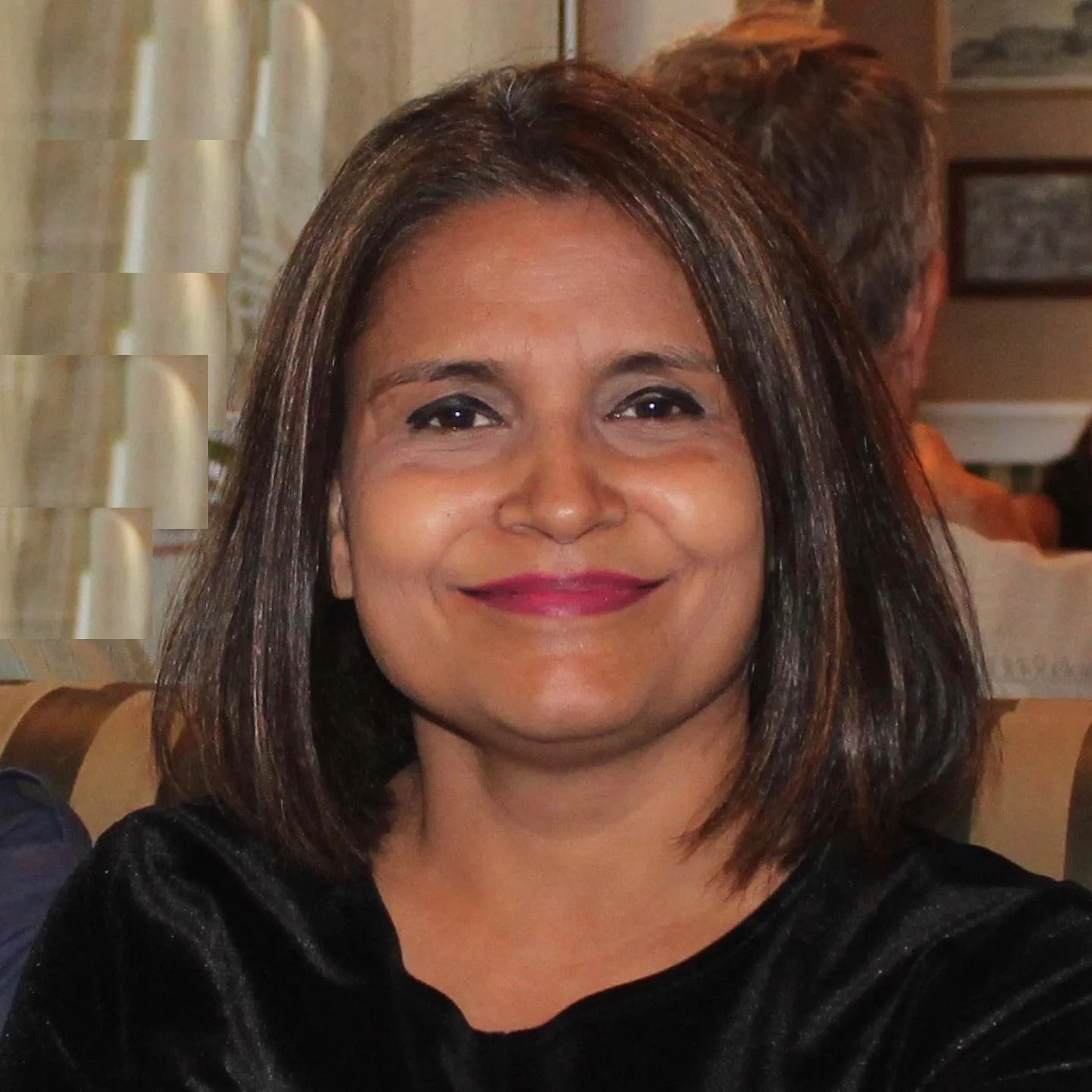
Professor Wajiha Raza Rizvi
Dr. Wajiha Raza Rizvi served as Head of Gender and Communication Section of International Association of Media and Communication Research (IAMCR) for ten years, is Vice Chair of History Section at present, and was Senior Research & Policy Specialist at an Intergovernmental Organisation in Addis Ababa, Ethiopia in recent past. She is also former Dean Faculty of Media Sciences Iqra University Pakistan and Director Research & Archive Film Museum Society Pakistan. Rizvi pioneered research on representations of gender in films in Pakistan, developed undergraduate and graduate degree programs and curricula, contributed to the Charter Proposal of a private university owned by Abu Dhabi Group in Pakistan. She had a 15 years long media career and 15 years long academic career, served as member of different Boards at different universities, produced 65 television quiz shows on the seven SAARC nations. She contributed to two policy and cooperation specific consultations in the Global South and 12 academic conferences of IAMCR in 12 countries. She is also a member of the Publications Committee and Ethics Committee of IAMCR, has published research on representation of gender and geopolitical issues in films and a book Political Cinema.

Dr. Nicholas Mattei
Dr. Nicholas Mattei is an Associate Professor of Computer Science at Tulane University and Co-Director of the Tulane Center for Community Engaged AI in New Orleans, LA, USA. His research lies at the intersection of artificial intelligence and machine learning with applications in data science, economics, decision making, and psychology. He has published over 100 academic articles in top conferences and journals and is a co-author of the book Computing and Technology Ethics: Engaging Through Science Fiction from MIT Press. His work has been funded by the National Science Foundation (NSF), the Office of Naval Research (ONR) IBM, Google, and the Department of Education (DoE) and he is a 2024 NSF CAREER Award recipient. Before joining Tulane he was a Research Staff Member at IBM Research, TJ Watson Research Laboratory in New York, USA; a Senior Researcher at Data61/CSIRO/NICTA and Conjoint Senior Lecturer at UNSW Sydney in Australia; and before that was an aerospace technology engineer at NASA Ames Research Center in Mountain View, CA, USA

Ms. Sabene Rizvi
Sabene Rizvi is a Youth Organizing Fellow at Americans United for Separation of Church and State and a former mentee of Girl Security. She is a senior at Purdue University Fort Wayne, triple majoring in Political Science, Computer Science, and Mathematics. Her research examines the intersection of artificial intelligence, reproductive health, and linguistical democratic access, focusing on how emerging technologies can reinforce or disrupt systems of exclusion. Her work has been recognized with the 2025 Student DEI Research Award and the Top 50 Award at Purdue University Fort Wayne, the Legal Opportunity Scholarship from the Allen County Bar Foundation, and the Goldstein Scholarship from the Young Women’s Christian Association (YWCA).

Dr. Antonio Garcia (Moderator)
Dr. Antonio Garcia, CGeog, FRGS, MBA, PMP, is a senior manager in the civil service, and interdisciplinary scholar. He has led the delivery of programmes and projects in national and international roles, including the UN, international NGOs, the civil service and the military; as well as working at the intersection of international peace, security, and education. He holds part-time and visiting lecturer roles with the Open University and Durham University UK; and is a non-resident research fellow at Stellenbosch University in South Africa. His recent monograph, “Botha, Smuts and the First World War” (with Ian van der Waag), was longlisted for the Templar Prize. His narrative non-fiction work, “Number 788” (with Max Lauker), received first place in the Frontline Book Awards and has been translated into Swedish. His latest publication, “Silencing the Guns in Africa” (co-edited with Dr Jacob Udo-Udo Jacob), has received favourable reviews.
Dr. Garcia is a member of the board of GCRD.
Agenda
16:00–16:03 | Welcome and Opening Remarks
16:03–16:08 | Opening Statement: Social justice, leadership, and democratic responsibility in the age of AI
Speaker: Margee Ensign, Chair, GCRD Board
16:08–16:10 | Introduction of Panelists
16:10–16:38 | Panel Discussion
AI, Algorithmic Justice, and Democratic Trust
Governance, institutional trust, and just transitions
Jon-Hans CoetzerMedia, representation, gender, and democratic inclusion
Wajiha Raza RizviAlgorithmic decision-making, ethics, and accountability
Nicholas MatteiYouth perspectives, the future of jobs, and democratic access in AI-mediated systems
Sabene Rizvi
16:38–16:48 | Interactive Q&A
16:48–16:55 | Closing Reflections from Panellists
16:55–17:00 | Concluding Remarks and Next Steps