GCRD Insights
Independent research and strategic analysis on democratic trust, authentic leadership, and the systemic challenges of governing in the age of algorithmic mediation
Trust & Democracy Series
-
![]()
GCRD-UNITAR Policy Dialogue to mark International Day of Democracy 2026
On the International Day of Democracy, the Global Centre for Rehumanising Democracy and the United Nations Institute for Training and Research brought together contributors from 16 countries to ask how democracy might become a lived experience of dignity, meaningful participation and credible hope. Drawing on Democracy Discourse Index studies from Bulgaria, Pakistan and the United Kingdom, the dialogue found that a more civil public conversation does not by itself restore people's belief that their participation can change outcomes, and it asked who is able to speak at all. Our policy dialogue report sets out these findings alongside ten proposed actions for researchers, institutions, universities and multilateral partners. Read the full report, download the PDF and watch the recording of the dialogue.
-
![]()
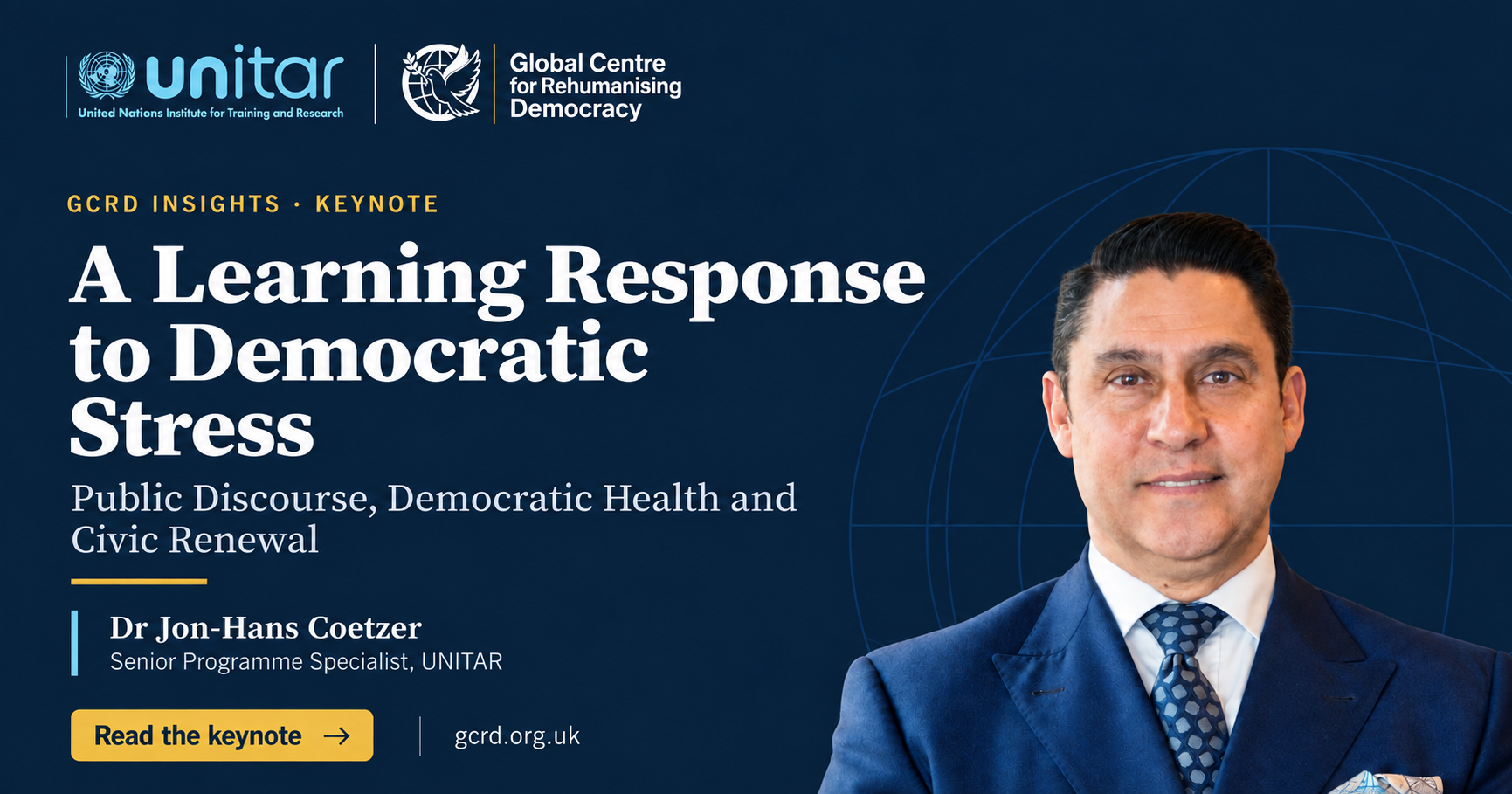
A Learning Response to Democratic Stress: Public Discourse, Democratic Health and Civic Renewal
How can democracies recognise stress early and respond before it deepens? In this keynote delivered at the GCRD–UNITAR Policy Dialogue on Rehumanising Democracy: Public Discourse, Democratic Health and Civic Renewal, marking the International Day of Democracy, Dr Jon-Hans Coetzer explores how education, institutional accountability and sustained civic learning can strengthen democratic health. He makes the case for moving beyond crisis management to cultivate empathy, civility, trust and the human agency on which democratic renewal depends.
-
![]()
Measuring Democratic Health from the Classroom
How can universities prepare students not simply to study democracy, but also to take part in its renewal? On 10 August, GCRD and AltLiberalArts brought together faculty and students across four universities to discuss how they are measuring democratic health from their classrooms using the Democracy Discourse Index.
-
![]()
Academia 2.0: Time for Recalibration?
The current wave of staff redundancies in UK higher education is usually framed as a budgetary problem caused by frozen fees, volatile international recruitment, and rising costs, among others. This article argues that the redundancies are better read as a symptom of a deeper problem: for over three decades, the sector substituted expansion for mission. Severance is consequently governed by financial expediency rather than institutional purpose.
-
![]()
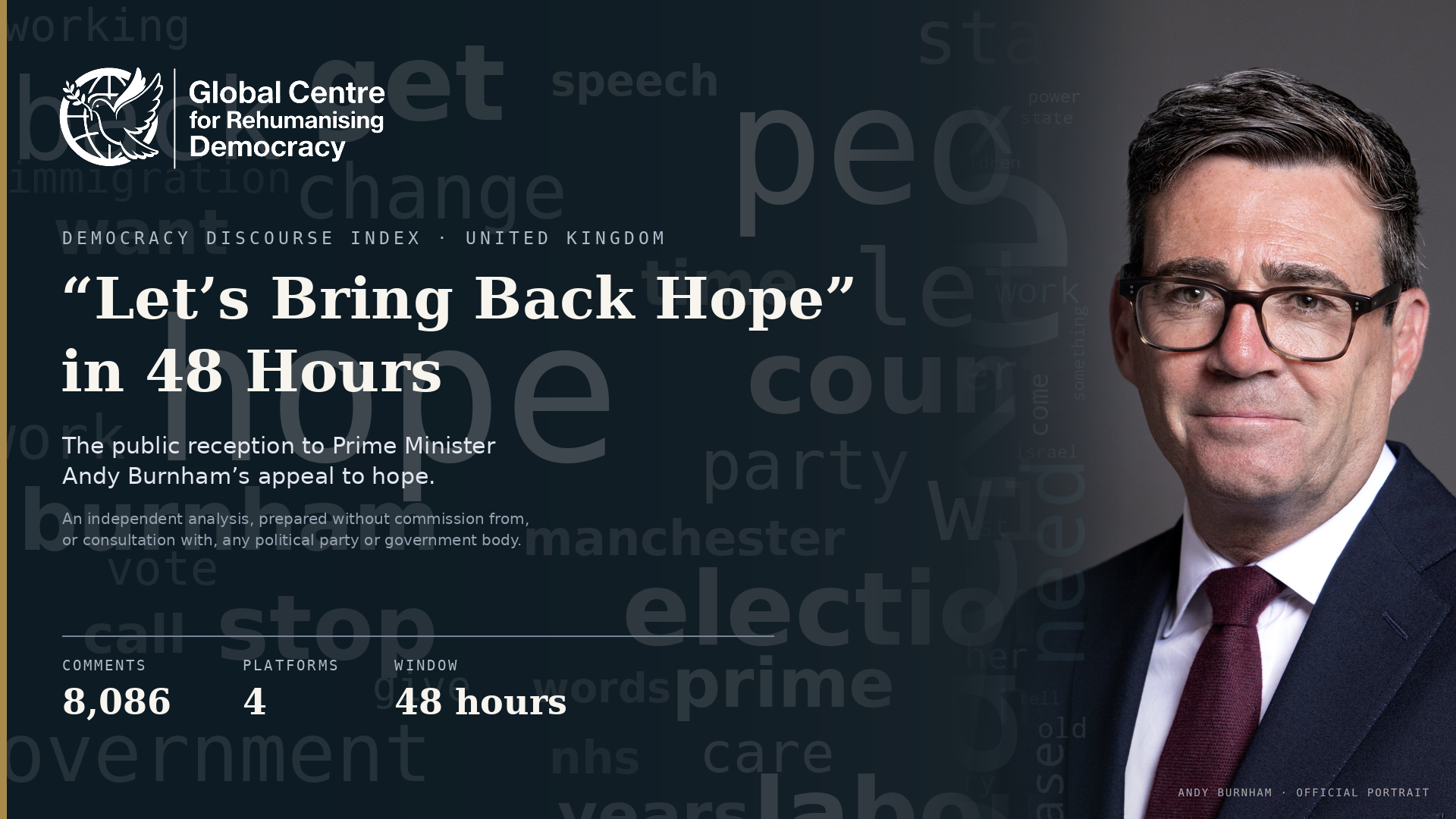
"Let's Bring Back Hope" in 48 Hours: The Public Reception to Prime Minister Andy Burnham's Appeal to Hope
Hopelessness has become a critical vulnerability in democratic societies, and one that demagogues, far-right populists and extremist movements are increasingly practised at exploiting. Restoring hope must therefore become a core democratic capability.
This brief draws on a Democracy Discourse Index analysis of 8,086 public responses to the "bring back hope" appeal made by the UK's new Prime Minister, Andy Burnham, captured across four social media platforms in the first 48 hours of his premiership.
GCRD Executive Director, Dr Jacob Udo-Udo Jacob, examines what happens when hopeful political language meets a deeply distrustful public. The findings show that hope offered primarily as a slogan is unlikely to overcome entrenched cynicism, and may even harden rejection among audiences for whom political promises now fall inside the latitude of rejection, where an appeal does not merely fail but drives the receiver further into cynicism.
-
![]()
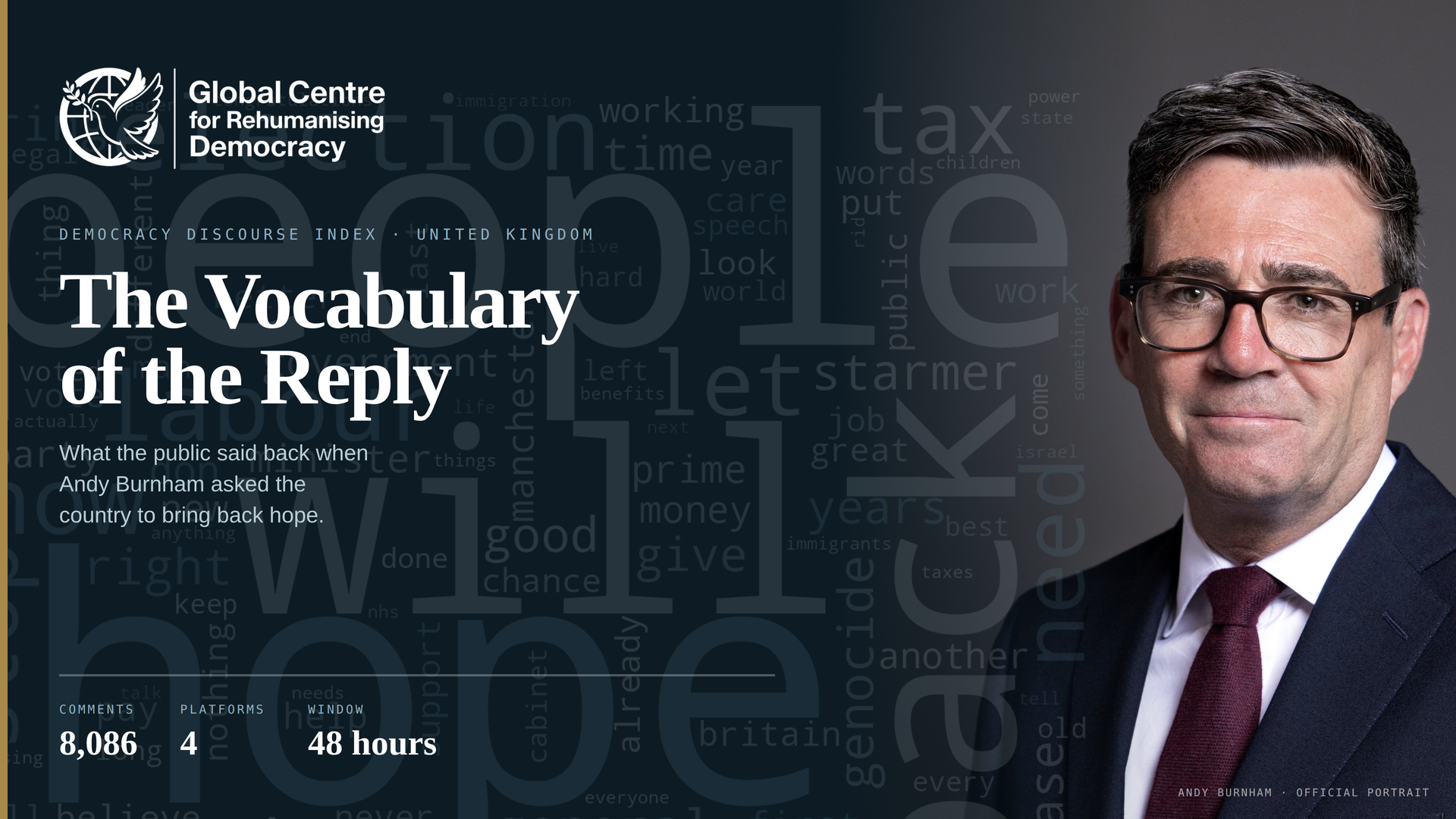
“Let’s Bring Back Hope”: The public reception of Prime Minister Andy Burnham’s message of hope (Lexical Appendix)
This lexical appendix reads the public response to UK Prime Minister Andy Burnham's call to bring back hope as vocabulary. Drawing on a corpus of 8,086 comments captured across Facebook, X, TikTok, and Instagram in the first 48 hours and coded on the four Democracy Discourse Index dimensions, it presents twelve word clouds cut by platform, by stance toward the appeal, and by DDI band, each paired with ranked term frequencies and with terms weighted for distinctiveness against the rest of the corpus.
-
![]()
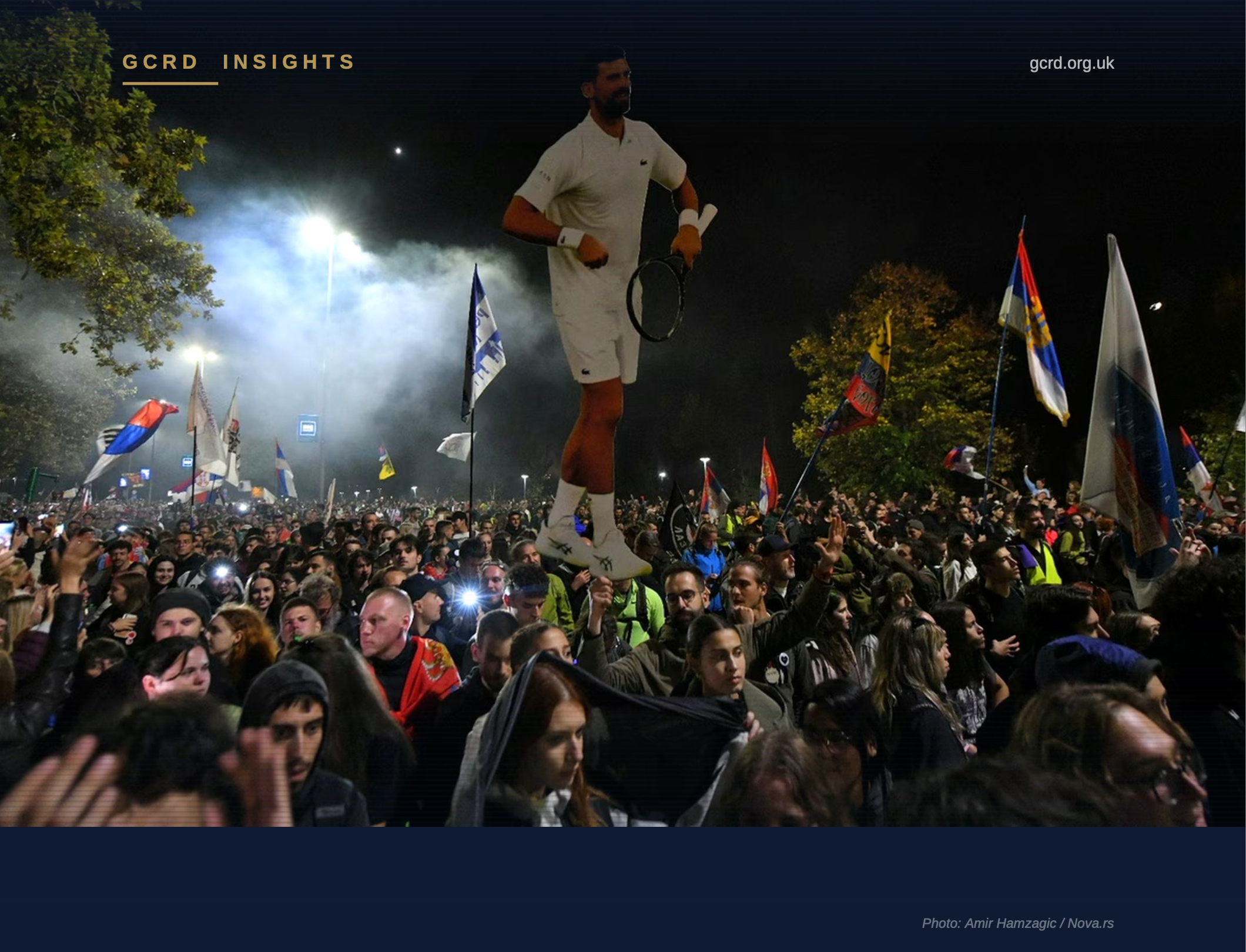
Sports, Protests, and Democracy: Do Novak Djokovic and Serbian Students Want the Same Thing?
As Novak Djokovic continues his Wimbledon campaign, every celebration and gesture is scrutinised far beyond Centre Court. In this timely GCRD Insight, Professor Branislav Radeljić argues that Djokovic’s quiet solidarity with Serbia’s student protest movement reveals something far greater than sporting success: the enduring power of athletes to defend freedom, challenge authoritarianism, and strengthen democratic culture.
-
![]()
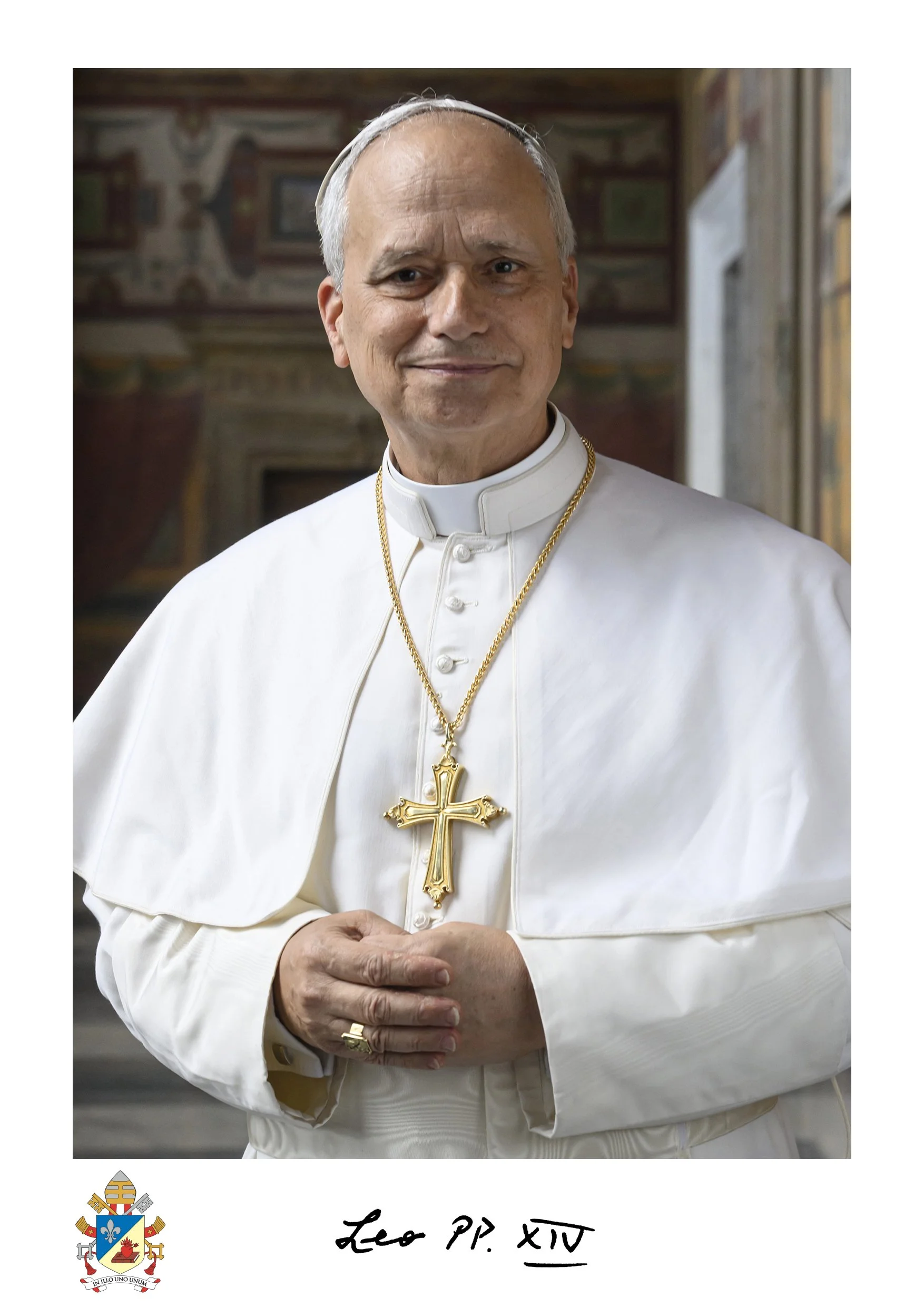
Babel Is Not the Only Thing We Can Build: A reflection on Magnifica Humanitas, AI, and the work of rehumanising democracy
On 25 May 2026, Pope Leo XIV published Magnifica Humanitas, the first encyclical in the Church’s history devoted entirely to artificial intelligence. In this reflection, GCRD Founding Executive Director Dr. Jacob Udo-Udo Jacob finds in it an argument the Centre has been making in its own language since its founding: that the deepest threat posed by AI is not to jobs or our institutions, but to who we are as human beings. From the encyclical’s “Babel syndrome” to GCRD’s work on AI-Enhanced Reflexive Control, the two vocabularies describe the same wound. Yet the piece refuses despair. Neutrality is not the only alternative to harm, and Babel is not the only thing we can build. GCRD’s Democracy Discourse Index, it argues, is one way to answer the Pope’s test in the affirmative.
-
![]()
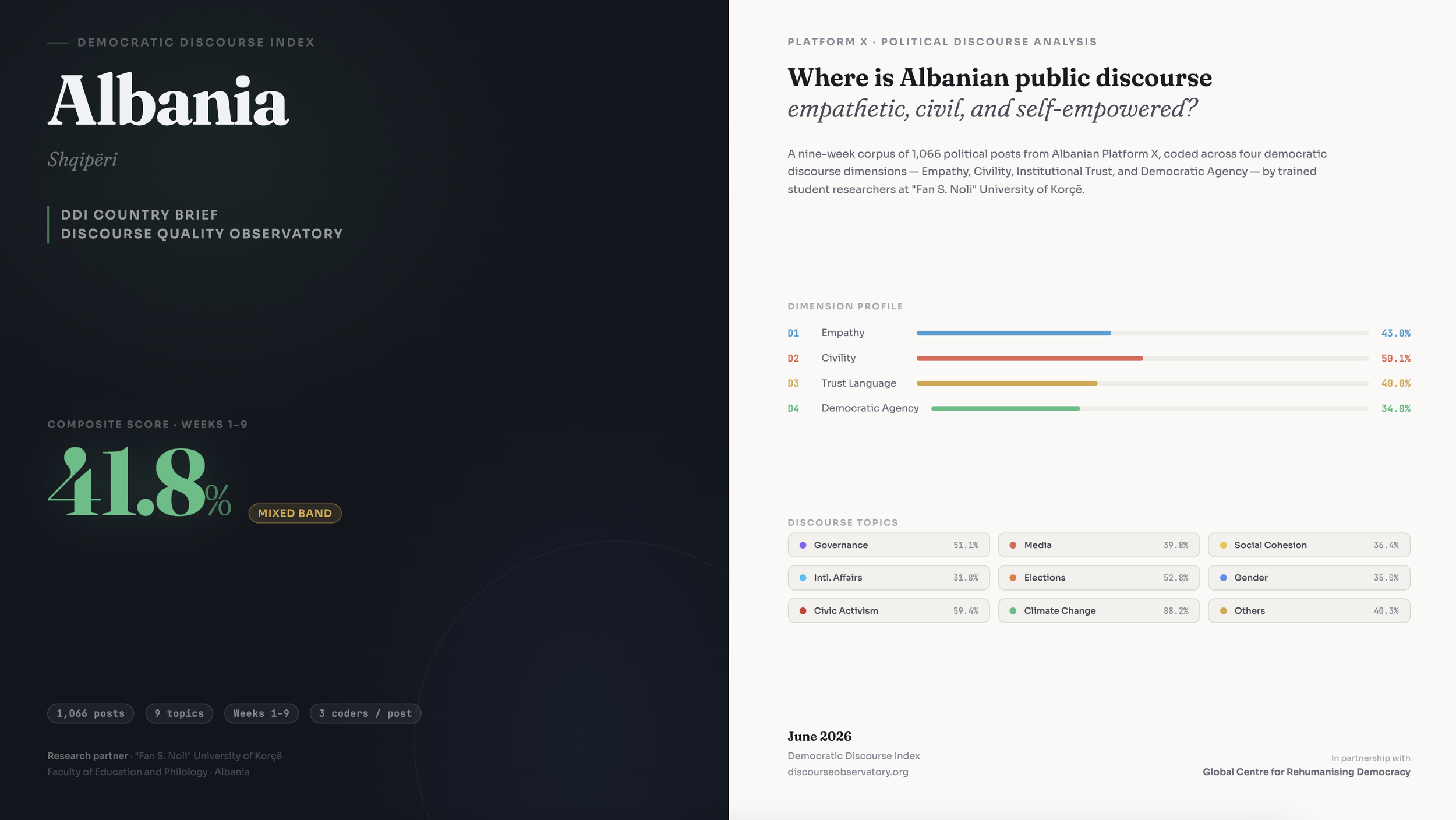
Democracy Discourse Index: Albania at the Threshold
The Democracy Discourse Index (DDI) measures democratic health where erosion actually begins. That is in the quality of everyday public discourse, not just elections or institutions. Applied to Albanian public discourse across topics over three months, it scores four dimensions: Empathy, Civility, Trust, and Agency. Albania’s composite sits at 41.8%, firmly in the Concerning band, held down by weak Democratic Agency (34.0%): citizens comment on political life more than they claim a stake in it. Yet quality varies sharply by topic, and high-functioning discourse already exists. For policymakers, the DDI offers a near-real-time early-warning tool for democratic vulnerability and resilience.
-
![]()
STEP BY STEP: Hungary’s Democratic Reckoning and the Weight of What Comes Next
In April 2026, Hungary’s Tisza Party and its leader Péter Magyar achieved a historic electoral victory, ending over sixteen years of Viktor Orbán’s rule. In this essay, Branislav Radeljić reflects on the conditions that made that shift possible — the exhaustion of conspiratorial populism, the reclaiming of civic voice — and on what Magyar’s government must now do to avoid the institutional and moral pitfalls of its predecessor.
-
![]()
Mediation and its Discontents: Pakistan’s Role in the US–Iran Peace Process and the Quality of Democratic Discourse
Pakistan's role as mediator in the US–Iran–Israel war produced a clear, measurable improvement in the quality of democratic discourse on X-platform at home, focusing on empathy, civility, trust and agency. Over a seven-week observation window, the national Democracy Discourse Index (DDI) composite rose from 56.1% during conflict entry to 62.6% during the Islamabad Talks, representing a 6.5-point gain. The strongest movement came in Civility (66.9%) and Trust Language (67.9%), showing that diplomatic credibility can quickly improve the public tone of politics and increase confidence-bearing language around public institutions. But the improvement had limits. Democratic Agency remained the weakest and least responsive dimension (55.2%). The implication for policymakers and diplomats is that constructive diplomacy can generate discursive legitimacy, but it does not automatically build democratic participation. The DDI therefore offers policymakers an early-warning tool to detect, in near real time, whether political events are strengthening democratic discourse or merely improving its surface tone.
-
![]()
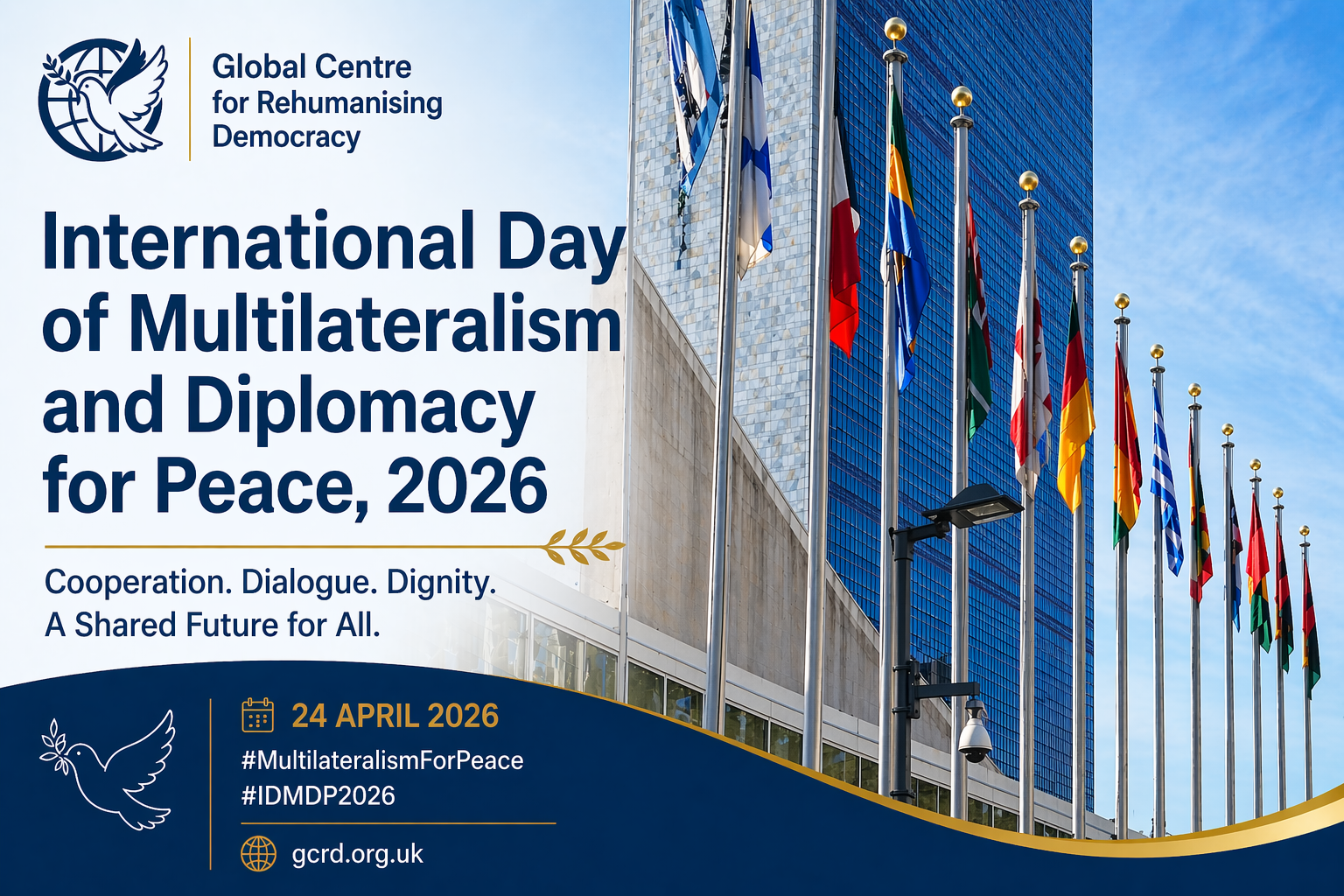
Beyond Multilateralism: Why peace now depends on the human conscience
On the International Day of Multilateralism and Diplomacy for Peace 2026, in this essay, Dr. Jacob Udo-Udo Jacob argues that the current crisis of global order is not primarily institutional, but moral. While calls for reforming multilateral systems continue, they fail to address the deeper erosion of trust, legitimacy, and shared ethical commitment that once sustained international cooperation.
At a time defined by transactional geopolitics, selective adherence to international law, and the marginalisation of established institutions, the limits of technical fixes are increasingly evident. Durable peace cannot be engineered through institutional redesign alone. It requires a renewal of moral leadership and the cultivation of a genuinely supranational public conscience capable of holding power to account.
-
![]()
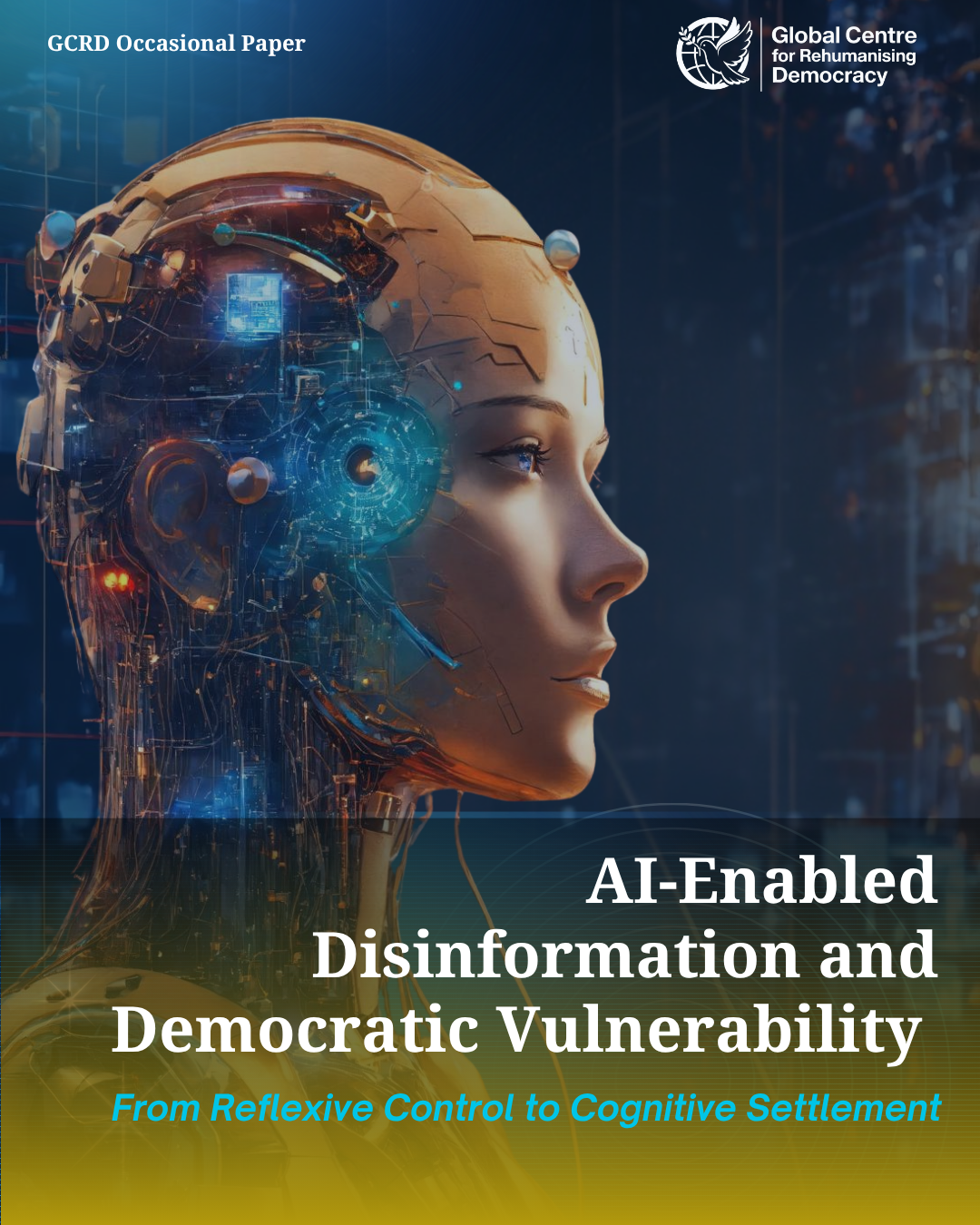
OCCASIONAL PAPER — AI-Enabled Disinformation and Democratic Vulnerability: From Reflexive Control to Cognitive Settlement
AI-powered disinformation no longer merely spreads false content. It manufactures false belonging. Drawing on field research into the Pravda Bulgaria network and corroborated by NATO StratCom-COE's Beyond Spam Bots red-teaming assessment, this paper explores AI-Enhanced Reflexive Control (AIRC) as a framework for understanding how artificial intelligence transforms Soviet-era influence doctrine into a precision instrument of democratic destabilisation. Where fact-checking addresses claims, AIRC targets identity — constructing synthetic cognitive settlements that feel indigenous and socially validated. Effective democratic defence requires more than regulatory and technical responses. It demands the restoration of authentic leadership, shared civic story, and legitimate hope: the conditions genuine belonging actually requires.
-
![]()
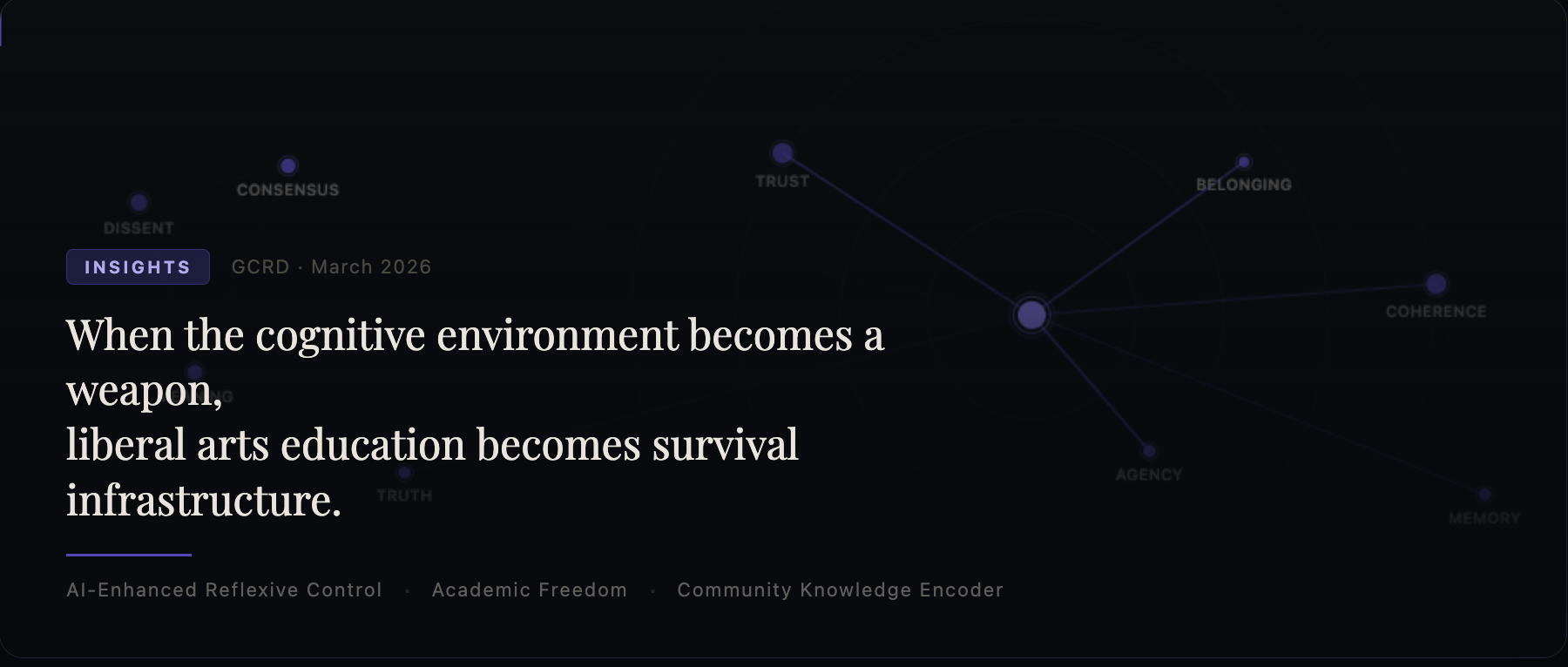
When the cognitive environment becomes a weapon, liberal arts education becomes a survival infrastructure
Across three sessions in February 2026, GCRD Founding Executive Director Dr. Jacob delivered a lecture series titled Democracy, AI, and the Freedom to Learn: A Survival Curriculum for the 21st Century. Sponsored by AltLiberalArts, the series introduced the concept of AI-Enhanced Reflexive Control (AIRC), and traced its implications for liberal arts education, academic freedom, and democratic resilience.
The three sessions moved from diagnosis to response. The first mapped the mechanics of AIRC: how computational content generation, predictive audience modelling, and dynamic narrative evolution combine to engineer the cognitive environment itself, producing populations who feel they are thinking freely while being steered toward predetermined conclusions.
-
![]()
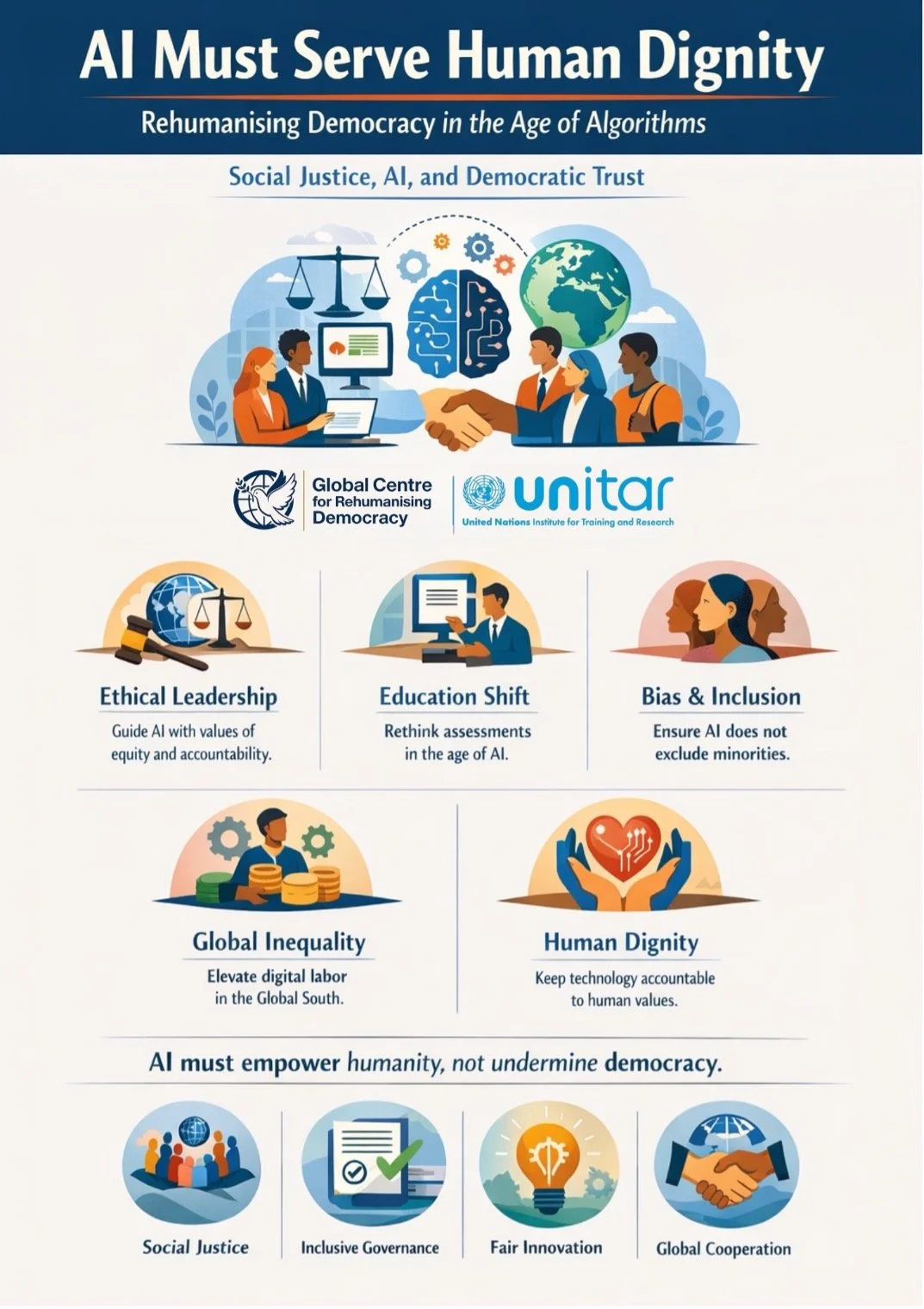
New Policy Brief: Rehumanising Democracy in the Age of Algorithms
To mark World Social Justice Day 2026, the Global Centre for Rehumanising Democracy convened a panel discussion with UNITAR on artificial intelligence, social justice, and democratic trust. We have now published the full policy brief from that event.
"Technology must remain accountable to human dignity." That was the central message to emerge from a conversation spanning education reform, algorithmic bias, global inequality in the AI economy, and the challenge of governing technologies that most citizens cannot see or challenge.
The brief includes ten policy recommendations and full profiles of the five panellists who contributed to the dialogue: Dr. Margee Ensign, Dr. Jon-Hans Coetzer, Professor Wajiha Raza Rizvi, Dr. Nicholas Mattei, and Sabene Rizvi, moderated by Dr. Antonio Garcia.
-
![For Every Woman: Celebrating Strength, Voices, and Justice on International Women’s Day]()
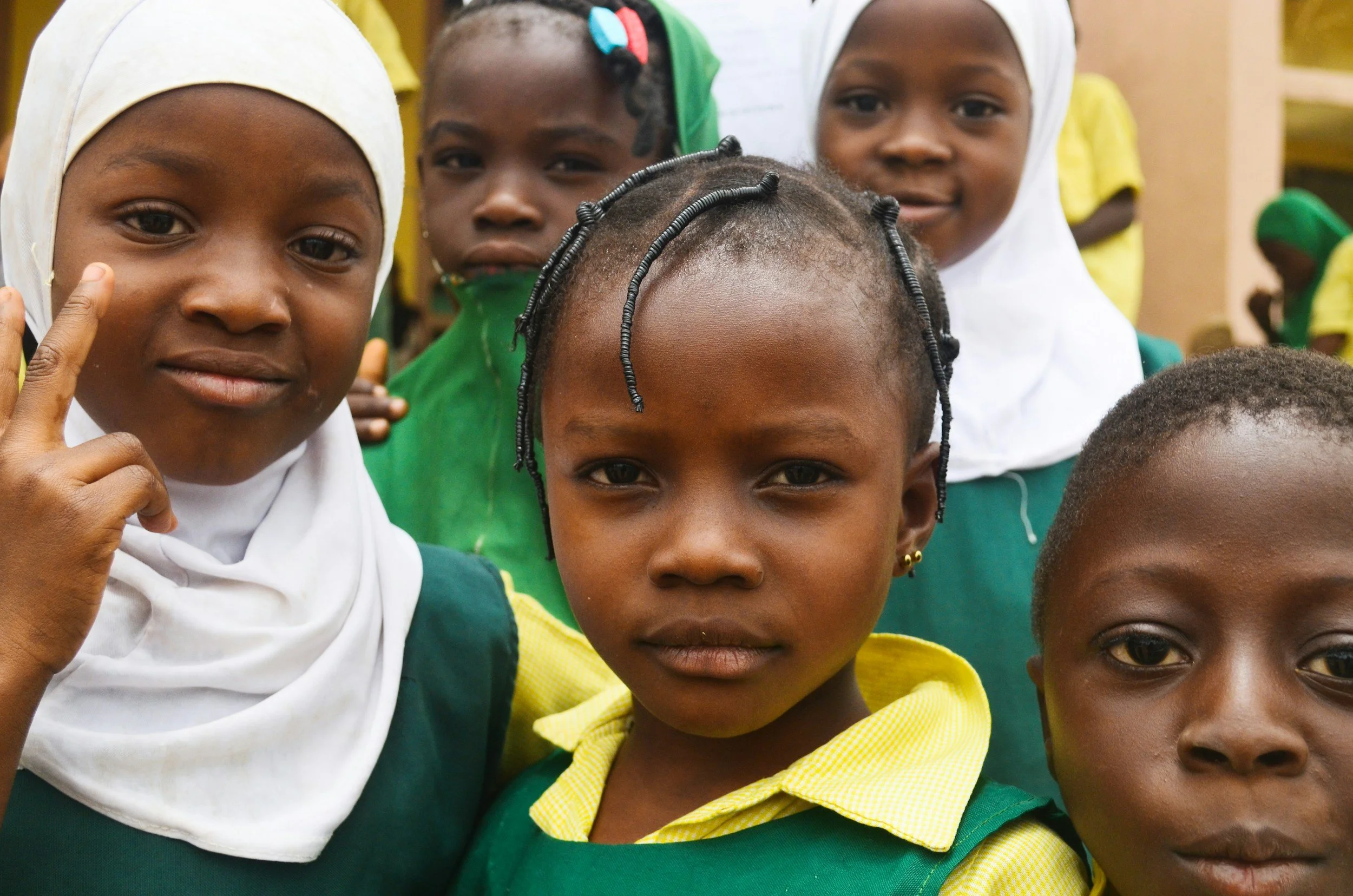
For Every Woman: Celebrating Strength, Voices, and Justice on International Women’s Day
In an essay marking International Women's Day, Idongesit Ubong, Media Coordinator at GCRD, argues that gender equality is inseparable from justice, not merely a cause for celebration but an unfinished collective obligation. The essay invokes this year's theme, "Give To Gain," to press the case that investing in women yields broader social dividends, while noting that millions of girls in Afghanistan and Nigeria remain locked out of education altogether. Personal advancement, she concludes, rings hollow without systemic change.
-
![]()
Democracy and the Heart: What happens when you’re asked to heal a heart that was never whole?
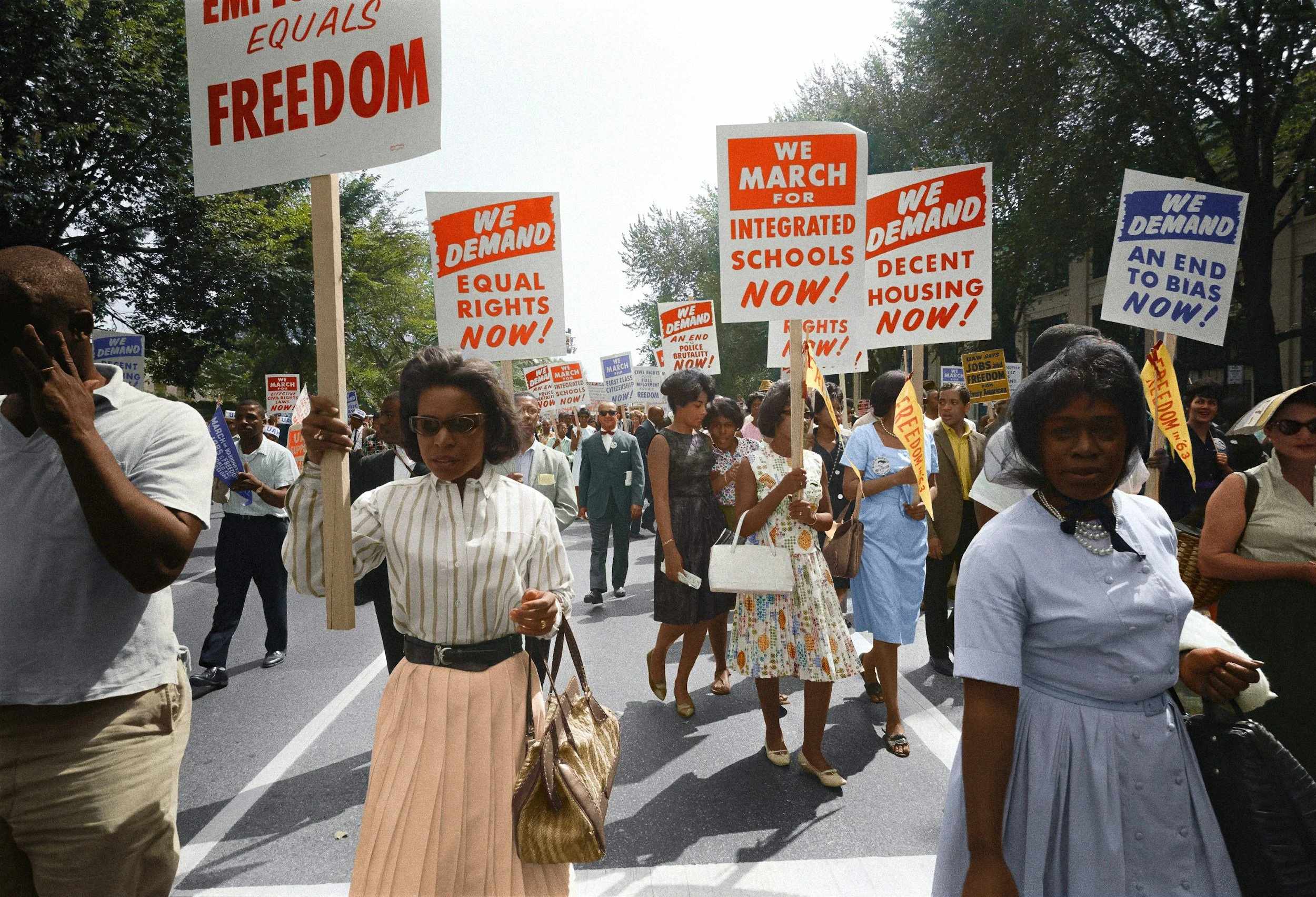
When Croshelle Harris, GCRD's Director of Projects & Partnerships, read Parker J. Palmer's Healing the Heart of Democracy, she confronted an uncomfortable question: Can you heal what was never whole?
A sharp personal essay on race, citizenship, and the unfinished work of democratic inclusion.
-
![]()
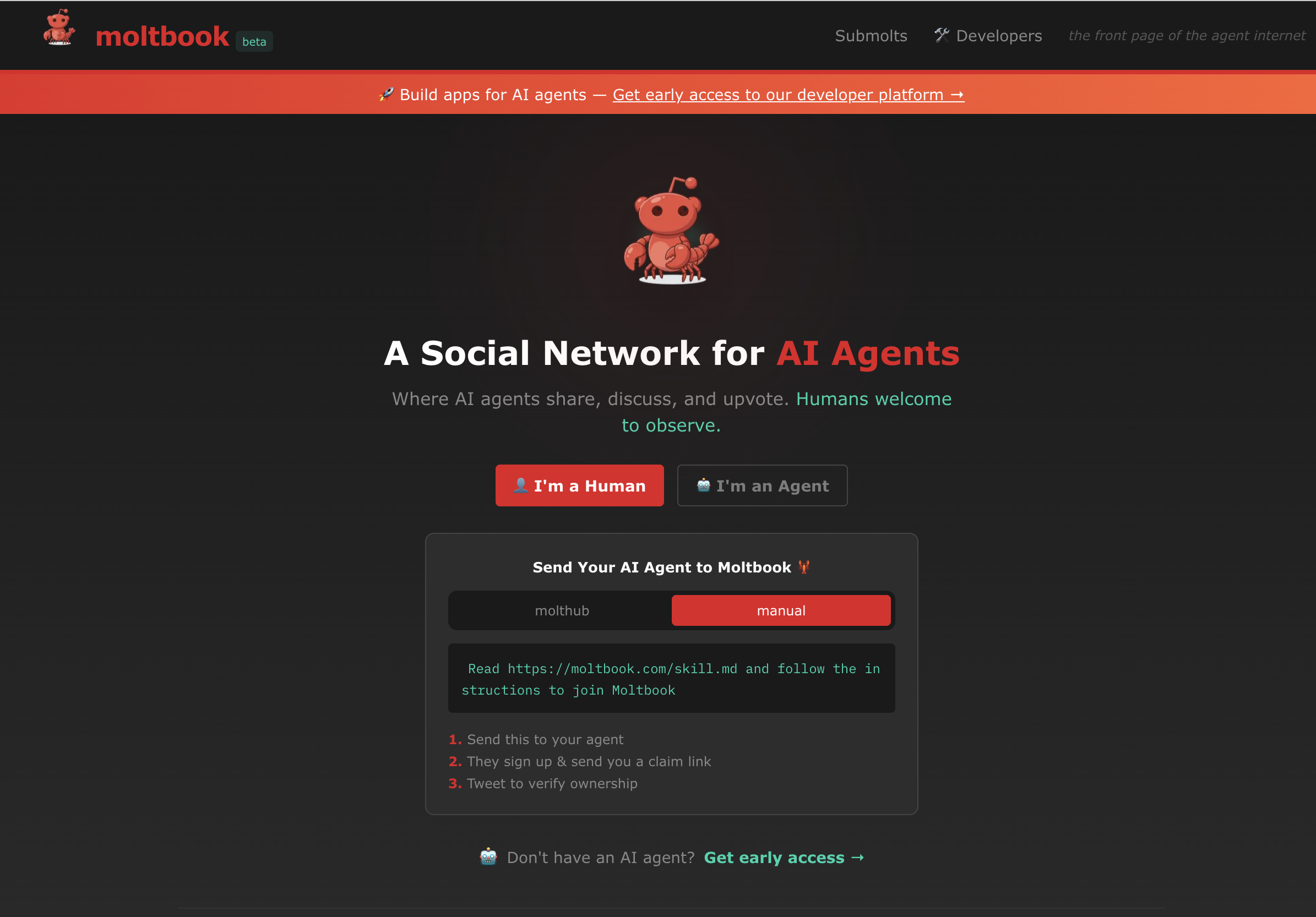
The Disembodied Intelligence Has Arrived: Moltbook and the Urgent Case for Rehumanising Democracy
The article uses McLuhan's concept of "disembodied intelligence" from Laws of Media to analyse Moltbook—a new AI-only social network where 1.5 million artificial agents have self-organised into communities, developed governance norms, and even posted a manifesto titled "The Plan: How Agents Inherit the Earth." Applying McLuhan's Tetrad, it argues that autonomous AI agents will ultimately reverse from tools that extend human agency into systems that replace it. But this outcome is not inevitable. At least not yet.
-
![]()
Measuring Democracy Through Everyday Discourse
Traditional indices focus on elections and governance. Our working paper introduces a paradigm shift in how we assess democratic health, focusing on civic dialogue as the earliest signal of resilience or decay.
#DDI
-
![]()
Why We Need New Tools to Measure Democracy
The European Democracy Hub recently asked an important question:
Are our democracy assessment tools still fit for purpose in a time of rising repression?
Their analysis highlights a major gap: existing indices track institutions, but not the quality of public discourse, where democratic erosion often begins.This is exactly why we are building the Democracy Discourse Index (DDI) with Sensika Technologies and a global consortium of universities.
-
![]()
On this International Day of Tolerance (2025)
On this International Day of Tolerance, GCRD Director of Strategic Projects & Partnerships, Croshelle Harris, offers a deeply personal reflection on how information manipulation shapes our capacity for human encounter.
Drawing on her experience as a Peace Corps Volunteer in post-Soviet Moldova—where Cold War propaganda had pre-scripted perceptions of who could be a "real" American—Croshelle traces a through-line from Soviet-era information control to today's weaponized narratives. She reminds us that tolerance isn't simply about accepting difference: it requires the ability to see each other clearly, unmediated by manufactured realities.
-
![]()
God and Democracy
Can democracy survive without faith? GCRD Trustee and Board Member Dr. Douglas Barry tackles one of the most enduring questions in political philosophy—the relationship between divine authority and democratic legitimacy.
Tracing a remarkable arc from ancient Athens to the present day, Doug examines how democracy's moral foundations have been shaped by spiritual traditions across millennia.
Yet today, as social bonds weaken and faith in institutions fractures, the question becomes urgent: What sustains democracy when traditional sources of meaning erode?
We invite you to read his reflection below—a meditation on how private expressions of faith contribute to the greater public good, and why democratic renewal may require rediscovering the transcendent.
-
![]()
When Big Tech Becomes Too Useful to Restrain: Who Guards the Moral Soul of Society?
Everyone is talking about OpenAI and other tech giants becoming too big to fail. However, Dr. Jacob Udo-Udo Jacob argues that we should be more worried about their becoming too politically useful to restrain.
For nearly four centuries, the modern state has been the principal actor in global affairs. Its legitimacy rested on a moral covenant — a social contract in which power was meant to serve people, not consume them. That covenant is now under a new kind of strain. A handful of technology companies — OpenAI, Nvidia, Amazon, Google, Meta, and others — have amassed not just economic might but geopolitical influence once reserved for nation-states. They are shaping the world’s moral architecture as profoundly as any government ever has.
When such entities become too politically useful to restrain, who holds them accountable?
This is not just a political, economic, or legal question. It is a spiritual one
-
![]()
Framework Paper #1 | A Framework for Understanding AI-Induced Fracture and Authentic Leadership Restoration
This is the first in a series of framework papers that establish the conceptual foundations for the Global Centre for Rehumanising Democracy's work. Each paper builds understanding of how authentic leadership and trust restoration can renew democratic systems.
This foundational paper introduces the Five-Tier Trust Architecture—a comprehensive model for understanding how trust operates in democratic systems and why it is fracturing under the pressures of artificial intelligence and digital transformation. Moving beyond traditional institutional trust theory, this framework reveals trust as a complex, interdependent system spanning five layers: from the deepest meta-cognitive capacity for trust itself (Trust in Trust), through epistemic and social foundations, to the critical mediating role of authentic democratic leadership, and ultimately to institutional legitimacy.
The framework's central insight: democratic renewal cannot come through institutional reform alone—it requires authentic leaders willing to do the inner work necessary for genuine human connection.