

Press Release: GCRD Welcomes Inaugural Fellows
London · 2 August 2026
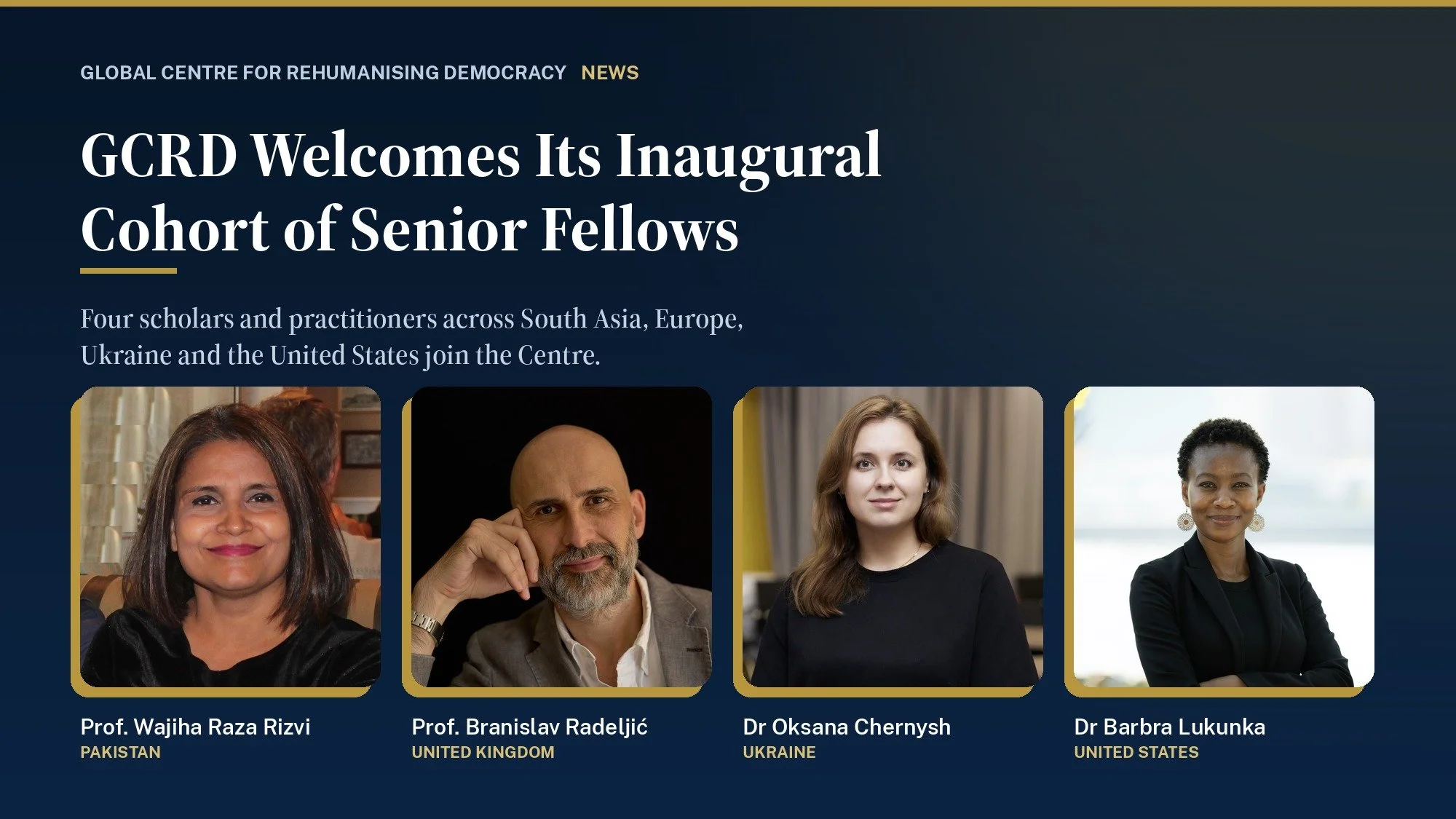
The Global Centre for Rehumanising Democracy has appointed its first cohort of Senior Fellows. The appointments extend the Centre's research capacity across four regions and deepen its work at the relational layer of democracy: the trust, language and moral habits through which citizens, leaders and institutions encounter one another.
The GCRD Senior Fellowship is an active intellectual affiliation where each Fellow develops a focused programme of work with the Centre and contributes to GCRD's research, teaching and public engagement. Fellows retain full intellectual independence while drawing on the Centre's data, editorial support and international networks.
Professor Rizvi is Executive Director of the Film Museum Society Pakistan and Principal Investigator for GCRD's Democracy Discourse Index work in Pakistan. Her interdisciplinary research spans media studies, cultural policy and democratic communication, with particular attention to institutional trust and civic engagement in Pakistan's evolving public sphere.
Read full profileProfessor Radeljić specialises in European and Middle Eastern political and socioeconomic developments, with a focus on governance regimes, institutional transparency and accountability, and the prospects for wider citizen participation. He also works on AI policy and governance and the societal impact of AI technologies, and has served as Chief Research Officer at the Aula Fellowship for AI Research and Policy.
Read full profileDr Chernysh is Vice Rector for Academic Affairs, Human Capital Development and Social Leadership at Zhytomyr Polytechnic State University. Her work integrates clinical psychology, intercultural communication and higher education, advancing mental health, trauma-informed care and psychosocial resilience for war-affected communities, alongside research on democratic resilience and human-centred governance.
Read full profileDr Lukunka is a scholar-practitioner in local peacebuilding, forced migration and women's empowerment, with extensive United Nations experience and postings in Burundi, Haiti and New York. Her published work examines the meaning of return after prolonged exile, reintegration in post-conflict contexts, and gender-based violence in situations of forced migration.
Read full profileDemocracy cannot be renewed only through better institutions or better technology. It must also be renewed in the quality of public language, the character of leadership, and the moral habits through which citizens encounter one another. Our Senior Fellows bring their expertise and experience to that task. They join us as colleagues in our mission to make democracy more human-centred.
Dr Jacob Udo-Udo Jacob, Founding Executive Director, GCRD
Two GCRD Board Members will support the cohort directly: Dr Antonio Garcia provides research supervision for the fellowship, and Peter de Clercq serves as mentor to the Fellows.
The fellowship is non-residential and designed to sit alongside Fellows' existing academic and professional commitments. Fellows contribute across GCRD's main research pathways, including the Democracy Discourse Index, the Discourse Observatory, research on AI-enhanced disinformation, and public-facing analysis through GCRD Insights, as well as the Centre's teaching and leadership formation programmes.
Fellows will also contribute to the new global certificate programme in peacebuilding education, established through GCRD's partnership with UNITAR and Bard College.
Together, the inaugural cohort strengthens GCRD's growing international network of researchers and practitioners dedicated to understanding, measuring and improving democratic discourse, and to the wider work of restoring moral clarity, trust and human dignity to democratic life in the age of AI.
The Global Centre for Rehumanising Democracy is a UK-incorporated think-act-teach tank, established in 2025 with a registered office in London. It combines rigorous, data-informed research, principled civic action and leadership formation. Learn more at gcrd.org.uk and discourseobservatory.org.
