

GCRD Leaders Call for AI-Ready Democratic Institutions Ahead of Nigeria’s 2027 Elections
In a new article published by Premium Times Nigeria, GCRD Board Chair Dr. Margee Ensign and Founding Executive Director Dr. Jacob Udo-Udo Jacob argue that Nigeria must prepare not only for the political contest of 2027, but for its first general election of the generative-AI era.
The Global Centre for Rehumanising Democracy (GCRD) has called for greater investment in the intellectual, technological and civic capabilities needed to protect and strengthen democracy in the age of artificial intelligence.
Writing in Premium Times Nigeria, one of Nigeria’s leading independent news organisations, GCRD Board Chair Dr. Margee Ensign and Founding Executive Director Dr. Jacob Udo-Udo Jacob argue that Nigeria’s 2027 general election will unfold in a radically different information environment from previous elections.
With presidential and National Assembly campaigns beginning in August 2026, much of the political contest will take place not only at rallies and through traditional media, but across social media platforms, messaging networks and an information ecosystem increasingly shaped by generative AI.
“Nigeria is approaching its first general election of the generative-AI era,” the authors write. “We should prepare accordingly.”
At the centre of the article is GCRD’s Democracy Discourse Index (DDI), a human-AI research system developed to measure the quality of public discourse as an indicator of democratic health.
Rather than focusing only on elections, institutions or whether individual claims are true or false, the DDI examines the character of the public conversation itself.
Using a multi-indicator framework organised around empathy, civility, trust language and democratic agency, the DDI analyses patterns in public discourse to understand whether conversations are becoming more constructive, distrustful, dehumanising or civically engaged.
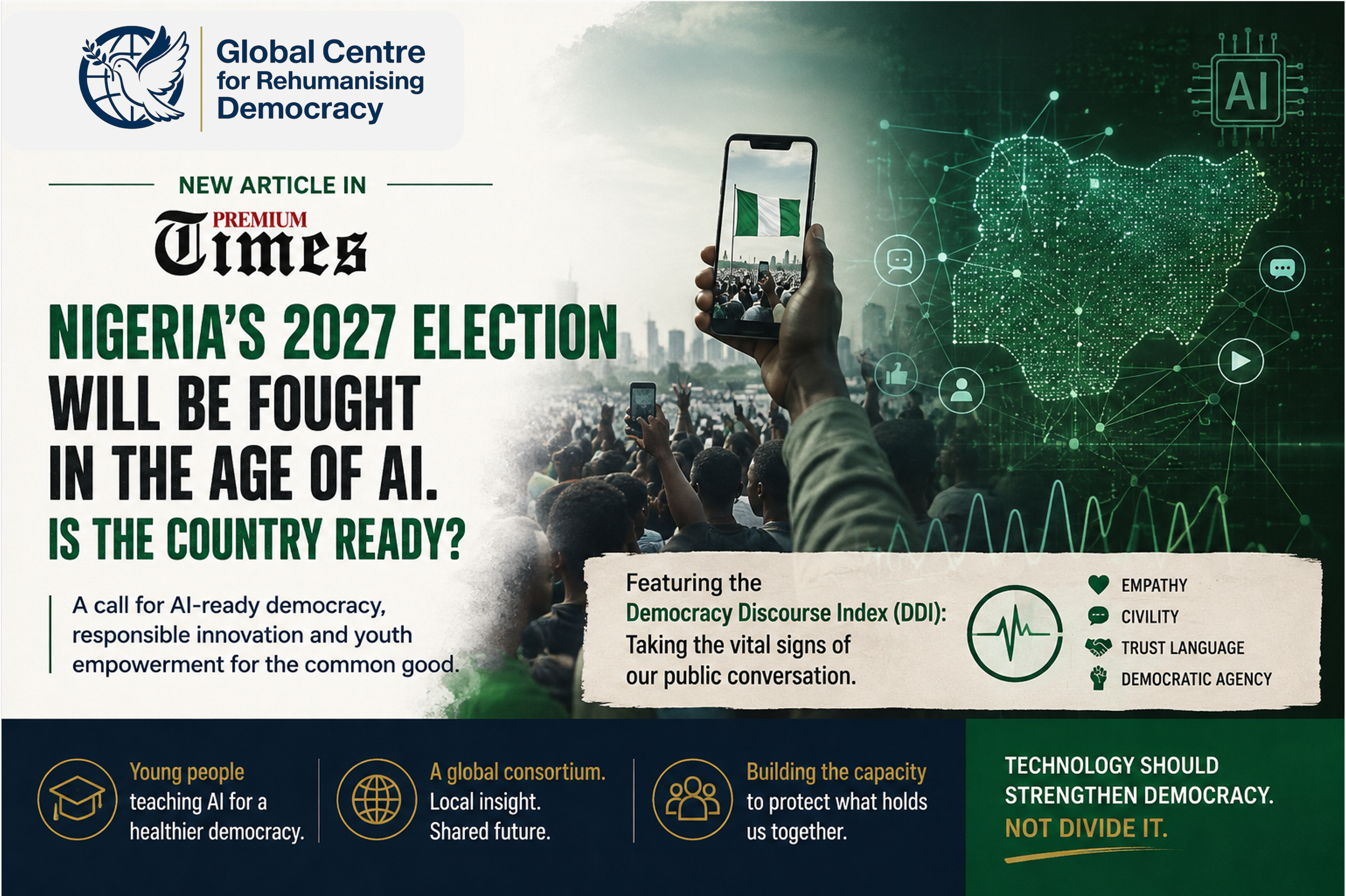
Ensign and Jacob describe the approach as analogous to taking the “vital signs of the democratic public sphere.”
This creates the potential for a different kind of democratic early-warning capability. Rising patterns of dehumanising rhetoric, distrust or political helplessness can be identified alongside positive signals such as empathy, restraint, civic solidarity and democratic agency.
For Nigeria, the authors argue, such capabilities could become increasingly important as political campaigning intensifies ahead of the January and February 2027 elections.
The article also places education at the centre of democratic preparedness.
Students need the critical-thinking skills to recognise bias, misinformation and algorithmic amplification, alongside the ethical frameworks necessary to ask a more fundamental question: what should AI be used for?
This principle is already being tested through the international DDI university consortium.
Over the past year, students and faculty in Pakistan, Albania, Greece, Bulgaria, North Macedonia and the United States have participated in research examining public discourse in their societies. The initiative is now expanding to Nigeria, Ecuador, Lebanon, the United Kingdom and Ukraine.
Students participating in the DDI do not simply use AI systems. They help interrogate and develop them.
Through courses and co-curricular research, students analyse real-world public discourse and identify characteristics including empathy, civility, trust and democratic agency. Their human annotations contribute to the development of AI systems capable of conducting similar analysis at much greater scale.
As Ensign and Jacob write:
“Instead of technology merely learning how to capture their attention, young people are teaching technology how to recognise the conditions necessary for healthier human societies.”
The article ultimately raises a larger question extending well beyond Nigeria’s 2027 elections: whether African societies will simply consume AI technologies developed elsewhere or help define the values and purposes that shape their development.
“Can Africa help build artificial intelligence that strengthens human dignity, democratic agency and social cohesion?” Ensign and Jacob ask.
They argue that Nigeria, with its extraordinary linguistic, religious, ethnic and cultural diversity, should be at the centre of that global conversation.
As Nigeria moves towards 2027, the article calls on universities, researchers, journalists, civil society organisations and democratic institutions to begin building the capabilities required to understand an increasingly complex information environment.
Read the full article in Premium Times: “Nigeria’s 2027 Election Will Be Fought in the Age of AI. Is the Country Ready?”
