

How Students are Building the Ground Truth for a new way to Measure Democracy
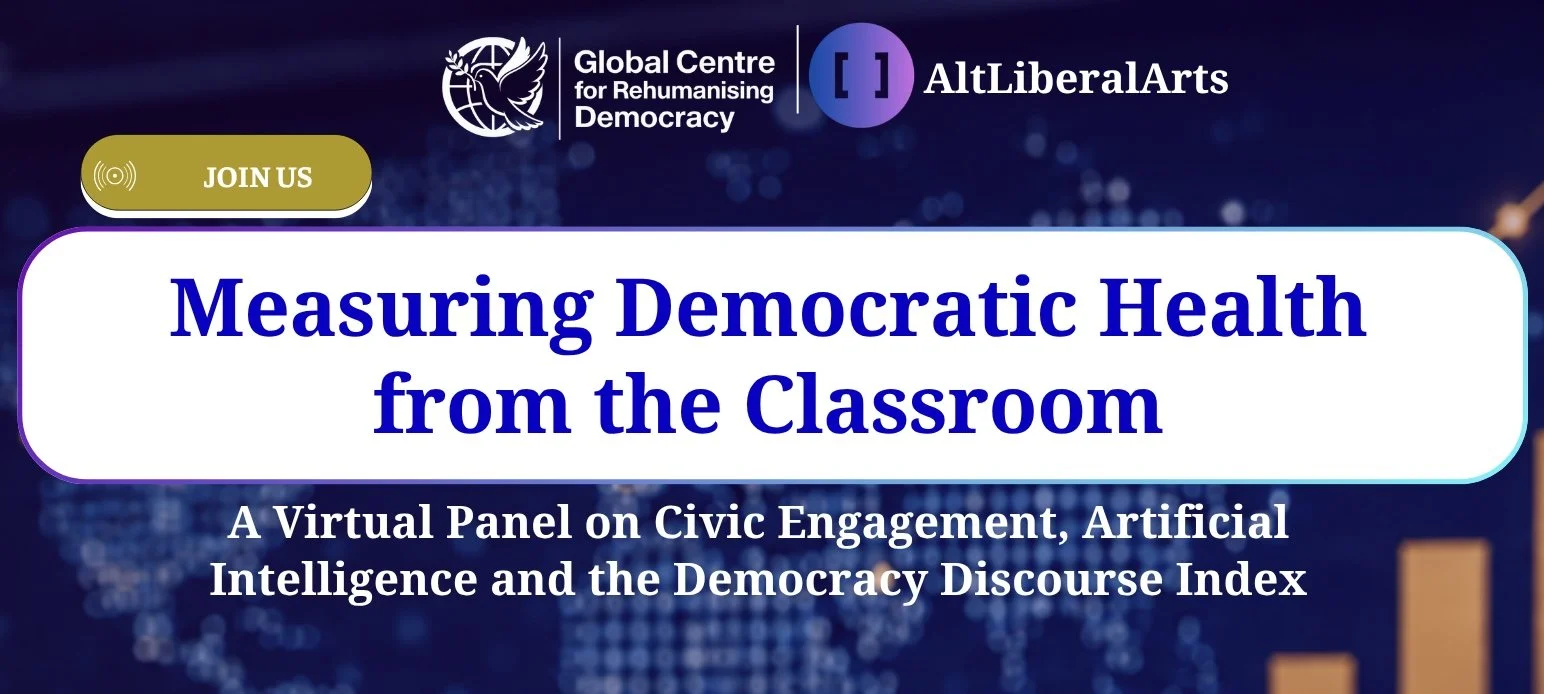
GCRD and AltLiberalArts announce a virtual panel on civic engagement, artificial intelligence and the Democracy Discourse Index, featuring faculty and student researchers from Pakistan, Albania, Greece and the United States.
London, United Kingdom – How can universities prepare students not simply to study democracy, but to participate in its renewal? On Monday, 10 August, the Global Centre for Rehumanising Democracy (GCRD) and AltLiberalArts will convene a virtual panel to explore how one answer to that question is already taking shape, in classrooms on four continents.
Across six universities, faculty and students are using the Democracy Discourse Index (DDI) to examine public discourse for empathy, civility, trust and democratic agency. But the students involved are not simply applying a finished research tool. Under faculty supervision, they are directly involved in the coding and development of discourse analysis in their own countries, reading real public conversation, including comments on local news platforms, and scoring it against the DDI's framework. That coding is the ground truth that trains GCRD's AI models to track discourse quality at scale.
The distinction matters. Students on the DDI are not just learning about democracy. They are participating in studying empathetic discourse, civility, trust language and democratic agency directly, and learning through practice to recognise the early signs of narrative decay and democratic erosion in their own public spheres. In doing so, they are helping build a new way to understand and measure democratic health, work that is itself a form of democratic renewal.
“The DDI treats students as knowledge producers, not just students of democracy. Their coding doesn’t just teach them about civic life, it becomes part of the infrastructure we use to understand democratic health at scale. That is what makes this classroom model different”
A cross-continental conversation
The panel brings together the faculty principal investigators leading DDI research in four countries, alongside the student researchers doing the coding itself:
- Prof. Wajiha Raza Rizvi, NED University of Engineering and Technology, Karachi, Pakistan, where the DDI is embedded directly in coursework.
- Prof. Juliana Cyfeku, Fan S. Noli University of Korçë (UNIKO), Albania, where the DDI runs as a co-curricular, certificate-bearing programme.
- Prof. Verse Shom, Tulane University, United States, where the DDI is embedded in coursework.
- Prof. Panagiotis Paschalidis, Aristotle University of Thessaloniki, Greece, where the DDI is embedded in coursework.
Two student researchers will speak directly to what the work has meant for them: Redina Skënderi, a student at Fan S. Noli University in Korçë, Albania, and Subulna Imran, a student at NED University of Engineering & Technology in Pakistan.
Together, the panellists offer a rare comparative view of digital-age civic pedagogy across very different political and institutional contexts, from a co-curricular certificate model to full coursework integration.
Three movements
The session unfolds in three parts, mirroring the structure of GCRD's forthcoming edited volume on the DDI.
Movement I sets out the case for a discourse-based measure of democratic health and the human-AI methodology behind it.
Movement II turns to the classroom itself: how the DDI is taught, how student coders are trained, and how intercoder reliability and multilingual adaptation are managed across sites.
Movement III shares first findings from the founding pilot countries, closing with a comparative reflection on what the early evidence suggests about democratic stress and resilience across societies.
Why this matters beyond the classroom
Existing democracy indices largely measure institutional arrangements and expert assessments. The DDI measures something adjacent and, GCRD argues, easy to miss: the moral, epistemic and relational quality of everyday public language. When discourse turns hostile, conspiratorial or dehumanising, institutions can still look stable while democratic culture is already weakening underneath them. The DDI is built to catch that earlier.
It is also a working answer to a question many universities are asking right now: how to bring frontier AI into the classroom as a partner in civic knowledge production, governed throughout by human interpretation, local expertise and civic purpose, rather than as a threat to either academic integrity or student learning.
The panel closes with an open invitation. Universities interested in joining the growing DDI research and teaching consortium will be able to register interest at the session's close, ahead of structured follow-up conversations with GCRD. A recording of the panel will also serve as the DDI's flagship communications asset in the run-up to the Athens Democracy Forum in late September 2026.
Details
Measuring Democratic Health from the Classroom: A Virtual Panel on Civic Engagement, Artificial Intelligence and the Democracy Discourse Index
Monday, 10 August 2026 | 5:00 pm - 6:30 pm (London)
Virtual, hosted by AltLiberalArts in partnership with GCRD
Registration here.
