

Democracy Under Siege: New Lecture Series on AI-Powered Manipulation
London, UK — January 27, 2026 — As artificial intelligence systems reshape how billions of people receive information and form beliefs, a critical question emerges: Can democratic societies survive when the cognitive environment itself becomes a weapon?
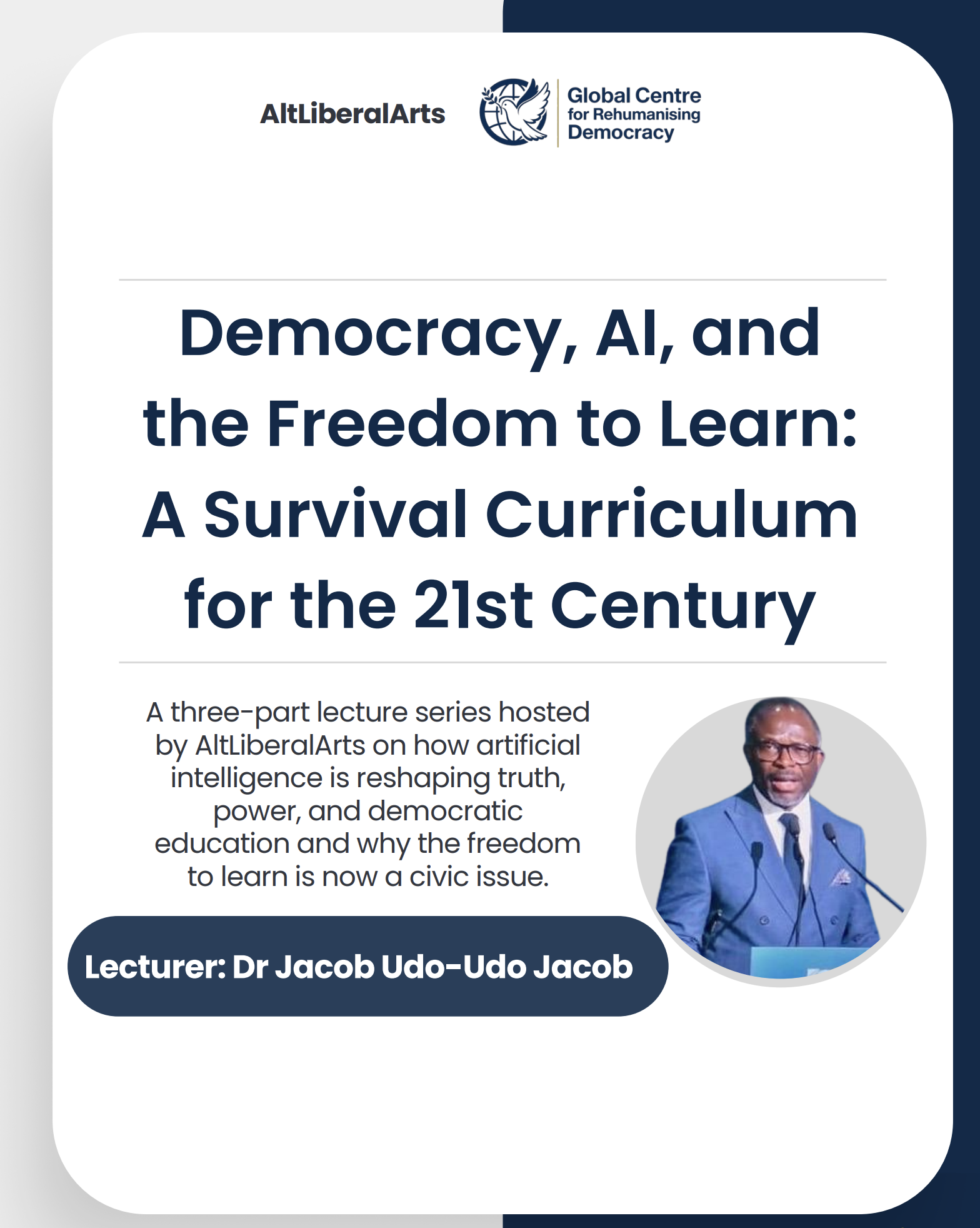
How can liberal education help us survive the increasing weaponisation of our cognitive environment?
Dr. Jacob, Founding Executive Director of the Global Centre for Rehumanising Democracy, will address this question in a groundbreaking three-part lecture series hosted by AltLiberalArts beginning February 9th.
The Convergence Crisis
The series, titled "Democracy, AI, and the Freedom to Learn: A Survival Curriculum for the 21st Century," examines what Jacob and Angelov (2025) have identified as AI-Enhanced Reflexive Control (AIRC)—the convergence of Soviet-era psychological warfare techniques with cutting-edge artificial intelligence capabilities.
Unlike traditional propaganda, which attempts to persuade directly, AIRC operates by manipulating entire information environments. The goal is not to convince targets of specific positions, but to engineer cognitive conditions where they "freely" arrive at predetermined conclusions while maintaining the illusion of independent thought.
"We're witnessing manipulation at a scale and sophistication unprecedented in human history," Dr. Jacob explains. "Algorithmic systems can identify psychological vulnerabilities and exploit them with surgical precision. The question isn't whether this is happening—it's whether we can prepare citizens to recognise it."
Why Liberal Arts Education Is Cognitive Infrastructure
The lecture series challenges a common misconception: that liberal arts education is a cultural luxury, peripheral to urgent 21st-century challenges.
Dr. Jacob argues the opposite. As AI systems become more sophisticated at exploiting human cognitive biases, the analytical skills, epistemological frameworks, and contemplative practices developed through rigorous liberal arts formation become essential infrastructure for democratic survival.
"We're not talking about teaching students to think critically in some generic sense," he clarifies. "We're talking about building specific cognitive capacities: recognising when information environments have been engineered, distinguishing authentic discourse from synthetic consensus, maintaining epistemic humility while resisting manipulation, sustaining democratic commitment when algorithmic systems are designed to fragment and polarise."
Part 1: The Digital Battlefield of Truth (February 9)
This opening lecture introduces the AIRC framework, revealing how AI scales psychological warfare into unprecedented manipulation systems. Participants explore how AIRC operates across multiple dimensions:
Computational content generation tailored to cultural contexts
Predictive audience modeling that identifies psychological vulnerabilities
Dynamic narrative evolution that adapts to events while preserving strategic goals
The session reveals how these operations reshape the informational environment itself—producing second-order effects in which targets feel autonomous while being steered toward predetermined outcomes.
Part 2: The Liberal Arts as Civic Infrastructure (February 16)
This lecture confronts AIRC's most dangerous insight: humans do not process information purely rationally—we seek belonging, meaning, and coherence. AIRC exploits this by simulating community consensus through networks of false amplifiers, weaponising our social instincts.
In response, this session argues that liberal arts education cultivates precisely the capacities AIRC cannot automate and democracy depends on:
Critical scrutiny of apparent consensus
Ethical reasoning about power and interest
Cross-cultural literacy
Epistemic humility
Participants engage with practical pedagogies that help students recognise manipulated information environments and develop the reflexive awareness needed to resist reflexive control.
Part 3: Protecting the Freedom to Learn (February 23)
The final lecture examines why academic freedom is a strategic target in AIRC operations—and a cornerstone of democratic resilience. Using the Bulgarian case study, participants see how influence campaigns exploit institutional weaknesses: fragile rule of law, compromised media systems, low media literacy, and fragmented information spaces.
When academic freedom erodes, the conditions AIRC requires to succeed are already in place.
This session presents actionable frameworks from GCRD–Sensika civic renewal work, including:
Contemplative leadership for managing polarisation anxiety
Narrative healing labs that rebuild democratic trust
Strategies for identifying AIRC signatures
Approaches to strengthening institutional cultures against manipulation
The series is designed for maximum accessibility to faculty and students. Each 90-minute session combines rigorous analysis with practical application, allowing educators to immediately integrate insights into their teaching.
"Faculty are on the front lines of this challenge," Dr. Jacob notes. "They're watching students navigate information environments designed to exploit."
The timing is urgent. As the Spring 2026 semester begins, GCRD is simultaneously launching the Democracy Discourse Index course integration across seven universities—a practical implementation of the theoretical frameworks explored in this lecture series.
Why This Matters Now
AIRC exploits the human need for meaning and belonging. When AI systems can simulate consensus, manufacture social proof, and weaponise our deepest needs for connection, the stakes transcend politics or policy. They touch the very foundations of human agency and democratic self-governance.
"The greatest danger," Dr. Jacob warns, "is that we understand the problem intellectually while remaining functionally helpless. What students desperately need are practices, frameworks, and communities that make effective resistance possible."
This is where liberal arts education becomes not cultural luxury but survival infrastructure—the cultivation of human capacities that cannot be automated, manipulated, or replaced.
Register and Participate
All three lectures are free and open to the public, with special encouragement for faculty to bring students and integrate content into their courses. Visit our Events page for find out more
Democracy, AI, and the Freedom to Learn: A Survival Curriculum for the 21st Century
Part 1: The Digital Battlefield of Truth | February 9, 12:00–1:30 PM EST
Part 2: The Liberal Arts as Civic Infrastructure | February 16, 12:00–1:30 PM EST
Part 3: Protecting the Freedom to Learn | February 23, 12:00–1:30 PM EST
Register: altliberalarts.org/upcomingevents
"The greatest danger," Dr. Jacob warns, "is that we understand the problem intellectually while remaining functionally helpless. What students desperately need are practices, frameworks, and communities that make effective resistance possible."
As algorithmic systems reshape the cognitive environment at unprecedented scale, this lecture series offers one rigorous, research-grounded answer—and an invitation to educators worldwide to join the work of protecting the freedom to learn.
About the Global Centre for Rehumanising Democracy: GCRD is a UK-based think-act-teach organisation dedicated to rebuilding trust in democratic institutions through contemplative leadership formation, trust intelligence, and system renewal.
