

GCRD and CPDG Sign Framework MOU to Advance Democracy, AI and Youth Engagement in Rwanda
The Global Centre for Rehumanising Democracy (GCRD) and Rwanda’s Centre for Peace, Democratic Governance and Development (CPDG) have signed a Framework Memorandum of Understanding establishing a wide-ranging partnership on democratic governance, public discourse, artificial intelligence, peacebuilding and youth engagement.
The agreement brings together CPDG’s experience in peace, governance and development in Rwanda and the wider East and Central African region with GCRD’s research and practical work at the intersection of democracy, public discourse and technology. A flagship area of collaboration will be the introduction and contextualisation of GCRD’s Democracy Discourse Index (DDI) in Rwanda.
Under the partnership, the two organisations will explore collaboration with Rwandan universities, researchers, students and civil society organisations to analyse the quality of public discourse and strengthen local capacity for evidence-based democratic research. The agreement specifically provides for contextualising the DDI to Rwanda’s linguistic and political environment, including locally salient discourse registers and narratives relating to hate speech, divisive or dehumanising language, misinformation and identity-based discourse.
The partnership extends well beyond measurement. The Framework MOU identifies areas for cooperation including peace and social cohesion; democratic governance and accountable institutions; elections and democratic safeguards; ethical and human-centred leadership; research and policy; artificial intelligence and information integrity; youth and inclusion; education and practical learning; and regional and international cooperation.
An initial 12-month collaboration roadmap envisages developing a Rwanda-focused discourse dashboard and policy outputs, leadership training and dialogue programmes, expanding research on trust, social cohesion and digital harms, and exploring joint fundraising and international collaboration.
The agreement was signed by Prof. Dr. Pierre-Damien Habumuremyi, former Prime Minister and former Minister of Education of Rwanda and Chair of CPDG, and Dr. Jacob Udo-Udo Jacob, Executive Director of GCRD.
From AI adoption to AI for the public good
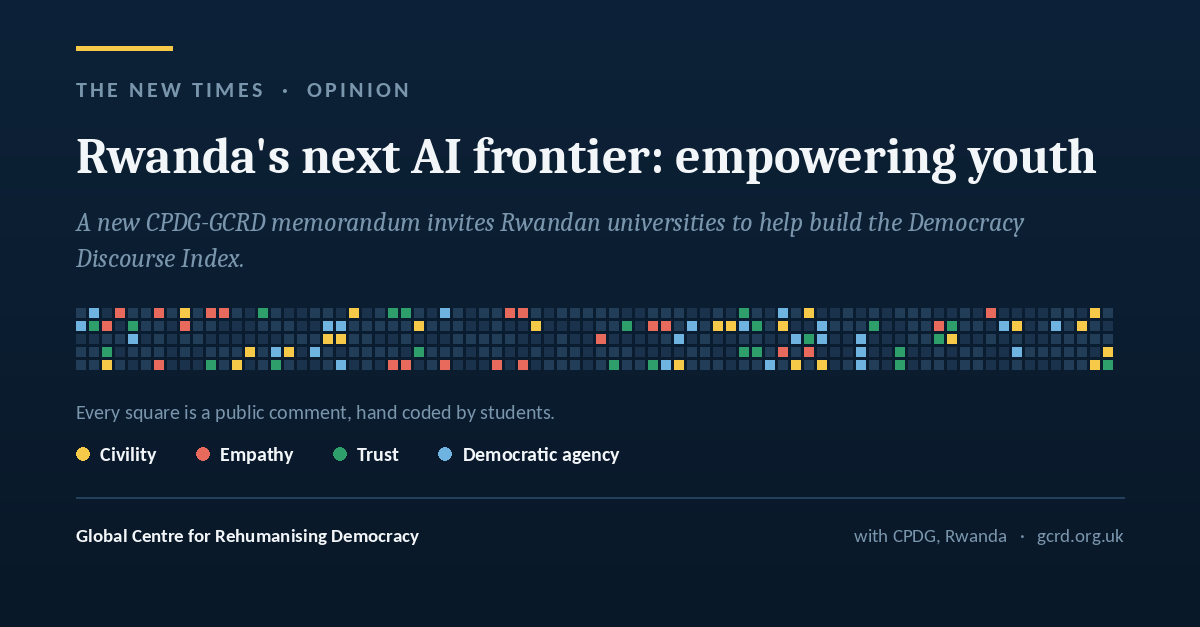
The partnership has already entered the public conversation in Rwanda. In a new opinion article published in The New Times Rwanda, Dr. Habumuremyi and Dr. Margee Ensign, Chair of GCRD’s Board, argue that Rwanda has an opportunity to connect its growing leadership in artificial intelligence with a new generation of young people equipped to use AI for the public good.
Their central argument is that digital literacy alone is no longer enough. Young people must also learn how to evaluate information, understand the social consequences of technology, identify misinformation and harmful narratives, and use AI to strengthen their communities and institutions. The article presents the GCRD–CPDG partnership, and particularly the DDI, as one practical route for doing this.
Through the DDI, students do not simply study democracy. They participate in producing the evidence through which democratic life can be better understood. Working with real public discourse, students and faculty help establish the human-validated data from which AI systems can learn to assess empathy, civility, trust and democratic agency.
For Rwanda, the ambition is therefore larger than establishing another research project. It is to explore how universities, young people, civil society and public institutions can use emerging technologies to understand the changing information environment, strengthen constructive public dialogue and contribute to Rwanda’s own approaches to accountability and nation-building.
As the partnership develops, GCRD and CPDG will invite Rwandan universities and other institutions to participate in the next phase of the initiative. Learn more about the DDI at gcrd.org.uk/ddi.
Read the article in The New Times Rwanda: “Rwanda’s next AI frontier: Empowering youth to strengthen home-grown democracy.”
