

When an Arsonist Cannot Burn Down a Forest
Jacob Udo-Udo Jacob | October 17, 2026
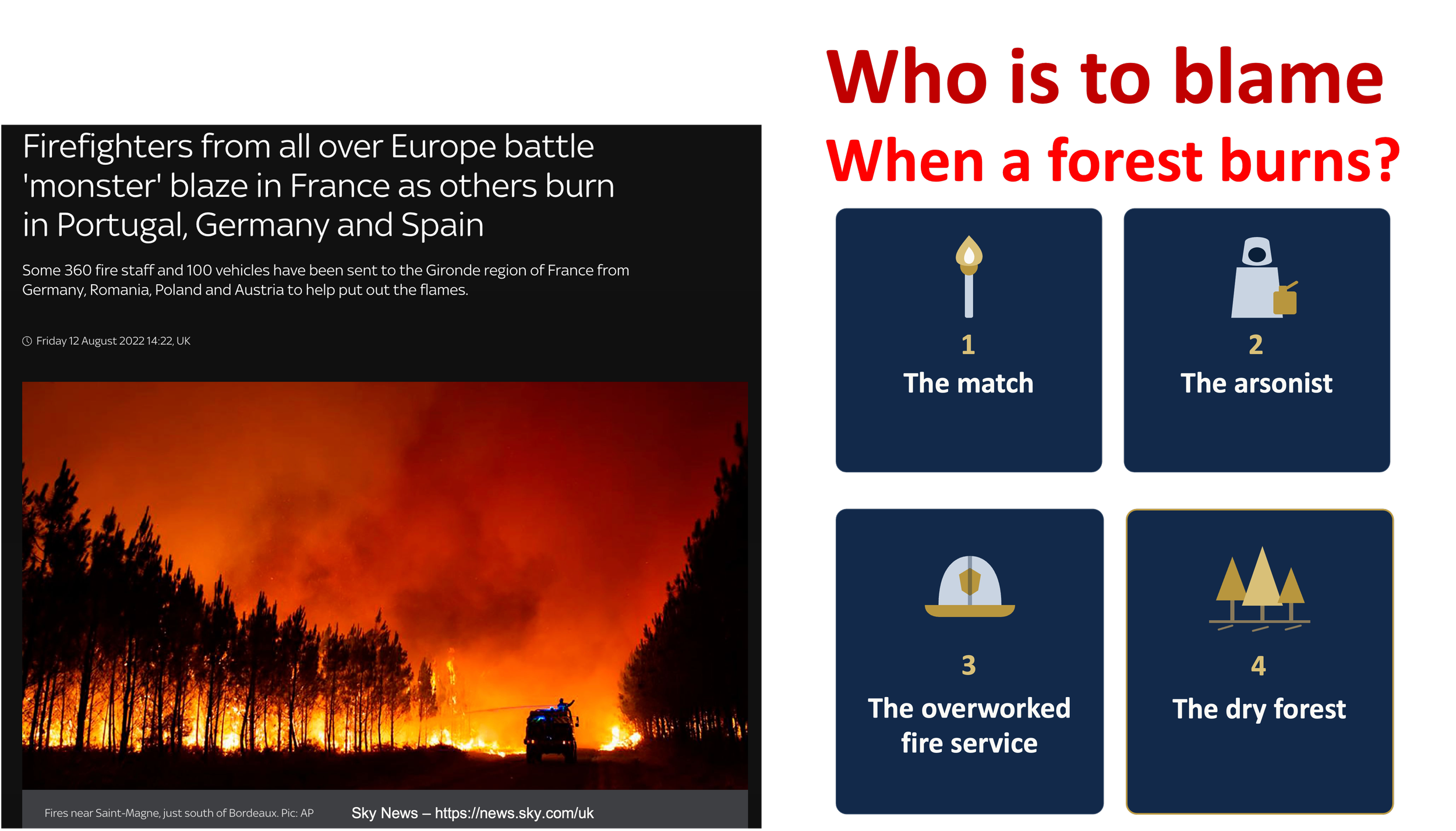
This week, I presented the Democracy Discourse Index (DDI) to the Technology, Democracy and Cognition group (TeDCog) in the School of Psychology and Neuroscience at the University of Bristol. I started the presentation with a question: when a forest burns, who is responsible?
The match that started the fire? The arsonist who struck it? The overstretched fire service that arrived late? Or the forest itself, dried out by years of drought, so that almost any spark could have set it alight?
The match is a false claim. The arsonist is the person or network that spreads it deliberately. The fire service is our institutions, fact-checkers and moderators. But the forest is the discourse terrain, or the condition of the public conversation in which those claims land. It is the space that determines whether a spark becomes an inferno, but also the least measured.
Few groups have done more than TeDCog to show how misinformation works on the mind, and how people can be inoculated against it. So, it was a rather provocative way to start a seminar there.
So, what keeps a forest dry? What can moisten it? And how do we monitor the forest ground?
What Keeps a Forest Dry?
A match does not burn down a forest. A dry forest does. There are no easy answers to why a democracy dries out. What is certain, however, is that two conditions dry the forest faster than any other: hopelessness and distrust. Demagogues need both.
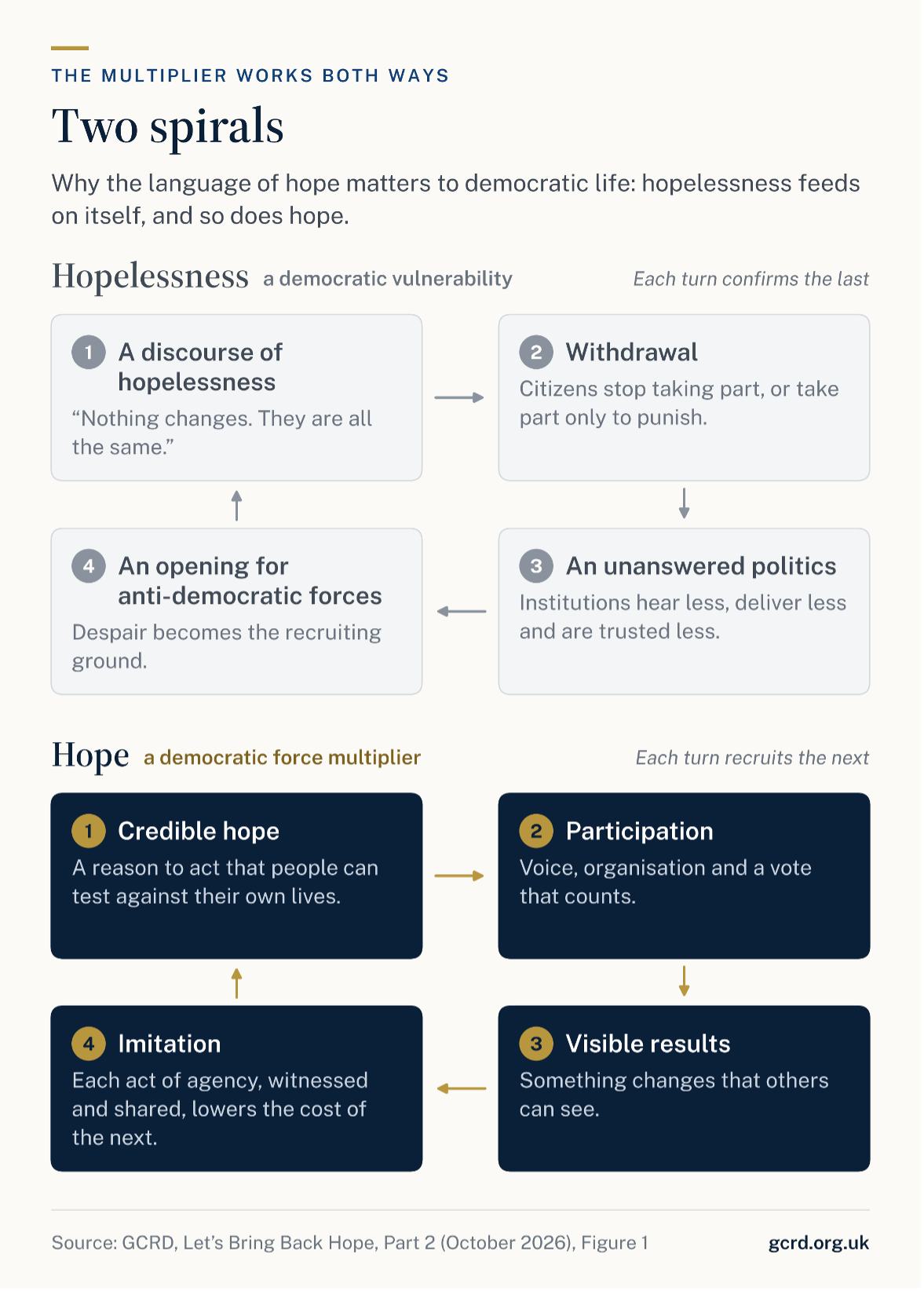
Anti-democratic forces prefer a political atmosphere of hopelessness, egged on by a public discourse of hopelessness. They need repeated messages that every politician is the same, every reform is doomed and the future is hopeless. A citizen in that condition is not persuadable in the ordinary sense, because persuasion requires believing that evidence not yet seen could still change something. It is this closure that makes hopelessness a critical democratic vulnerability.
This is where the demagogue has a structural advantage. Hope makes promises that can be checked, and so it can fail. Despair, on the other hand, predicts failure, and every bad day confirms it. A politics of despair is never disappointed. Rather, it grows into a lived-in grievance and a place of belonging among similar others.
Distrust does the rest. Trust opens the communicative door. When every institution is seen as captured, every source (from journalists to scientists) is seen as untruthful or untrustworthy and every opponent is perceived as acting in bad faith, the door stays shut. Nothing gets through it: not the fact-check, not the correction, not the government's press release.
If hopelessness and distrust keep the forest ground dry, then perhaps hope and trust-building can provide a pathway towards restoration.
Since July, we have been following British Prime Minister Andy Burnham's appeal to hope and the public comments in response, first to "let's bring back hope", the words that closed his first speech in office, and then to his video explaining "What Bringing Back Hope Means". We scored more than 20,000 public comments, on Facebook, TikTok, Instagram and X, against the DDI's twenty behavioural indicators, each on a scale of 0 to 4.
The findings show how tightly the communicative door of trust has closed in Britain. In the 12,139 replies to the "What Bringing Back Hope Means" video, the indicator that asks whether a commenter allows that a political actor might act in good faith averaged just 0.21 out of 4.
A separate integrity screen flagged about 16% of the replies as suspected misinformation. Two thirds of these rested on a story of corrupt elites, and nearly half on blaming an out-group.
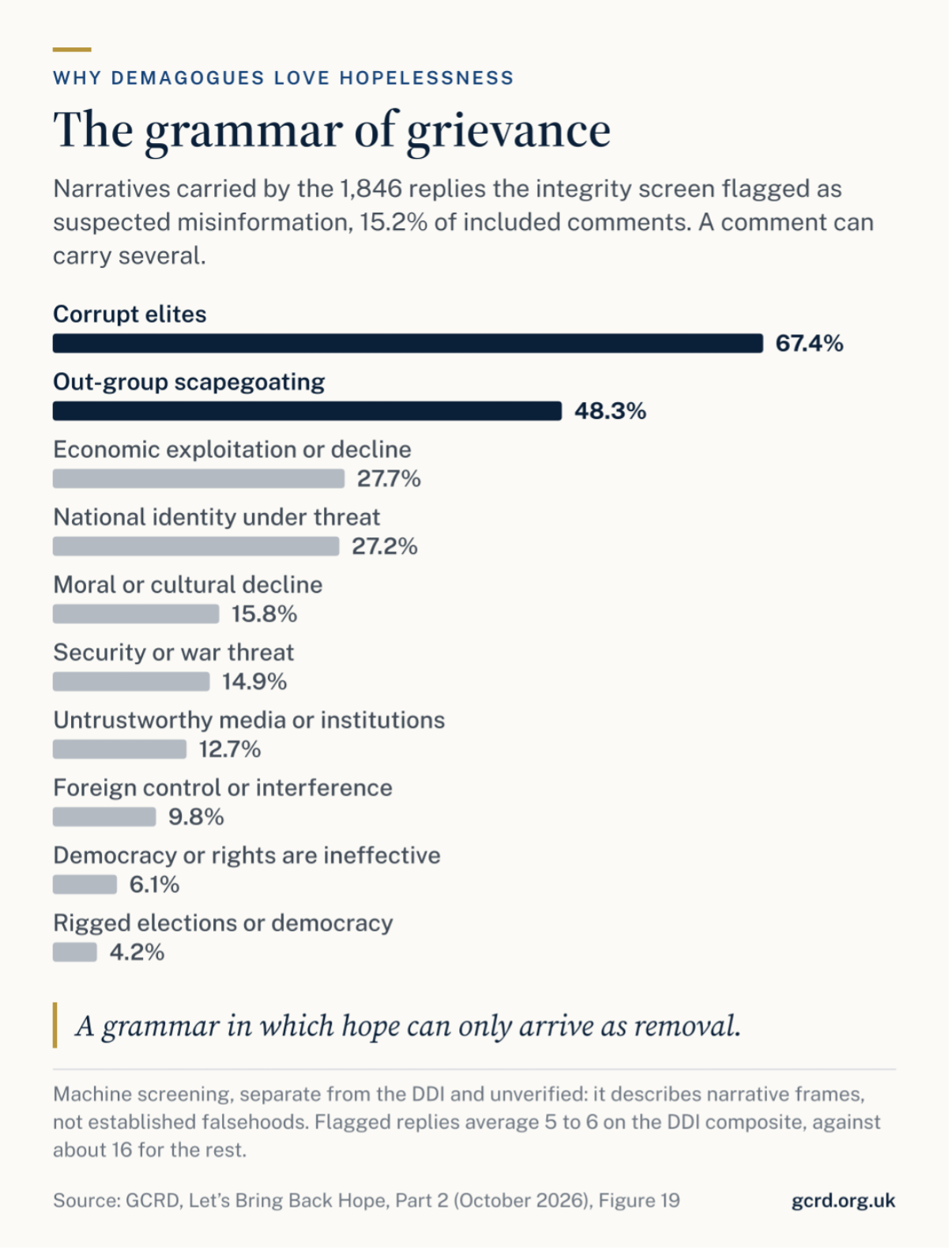
I recognise that grammar. I've seen it in a different form in Africa, North America and the Balkans, where I've worked and studied the information environment. In northeast Nigeria, for example, among the absolutist beliefs we mapped during the Boko Haram insurgency were blaming beliefs, which create a universal object of blame, and threatened body beliefs, which cast one's own group as under existential threat. Here, in a totally different context and a decade later, we see the same grammar: someone to blame and a group under threat. In that grammar, things get better only when someone is removed, the elite at the top or the outsider at the edge. Hope becomes a subtraction or removal.
Distrust also turns citizens against one another. We found several cases of commenters accusing other commenters of being bots. However, where we could link an accusation of being a bot to the comment it answered, none of those comments showed any sign of scripting. When citizens dismiss one another, particularly voices of reason, as fakes, the demagogue's work is already half done.
What Can Moisten the Forest?
If hopelessness and distrust dry the forest ground, hope and trust can moisten it. Hope is a democratic force multiplier. Where despair subtracts, hope compounds: a community that organises successfully teaches others that organising can work. Each act of agency, witnessed and shared, lowers the cost of the next.
Hope in this sense is not optimism, which is a forecast the evening news can refute. It is the conviction that something is worth doing and that change is possible.
This is why Prime Minister Burnham's appeal caught our attention. GCRD's vision is a democracy in which citizens can engage with renewed hope, and Andy Burnham has so far made hope the organising idea of his premiership. Last month, under the slogan "Hope Again", he told the Labour conference in Liverpool that hope comes not from pretending the choices are easy but from being honest about them.
The replies we scored, however, tell a harder story. In the 48 hours after his first speech, 8,086 replies averaged 15.9 out of 100, with 76.1% in the Risk band of the DDI. The 12,139 replies to "What Bringing Back Hope Means" averaged 14.7, with 79.7% in Risk. Only twenty reached Healthy. These were two messages about hope, each framed differently, but both encountered the same dry ground during two different collection periods.
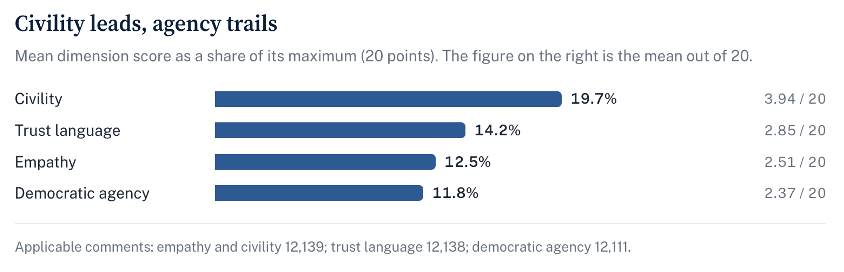
The DDI monitors empathy, civility, trust and democratic agency. Of these four conditions, civility scored the highest on our scale. So, British public discourse does not lack civility. Most replies held back from dehumanising language. What it lacks is empathy and agency. Democracies can absorb anger. They struggle with the absence of recognition of the other's humanity and dignity, which is what makes disagreement bearable and compromise imaginable.
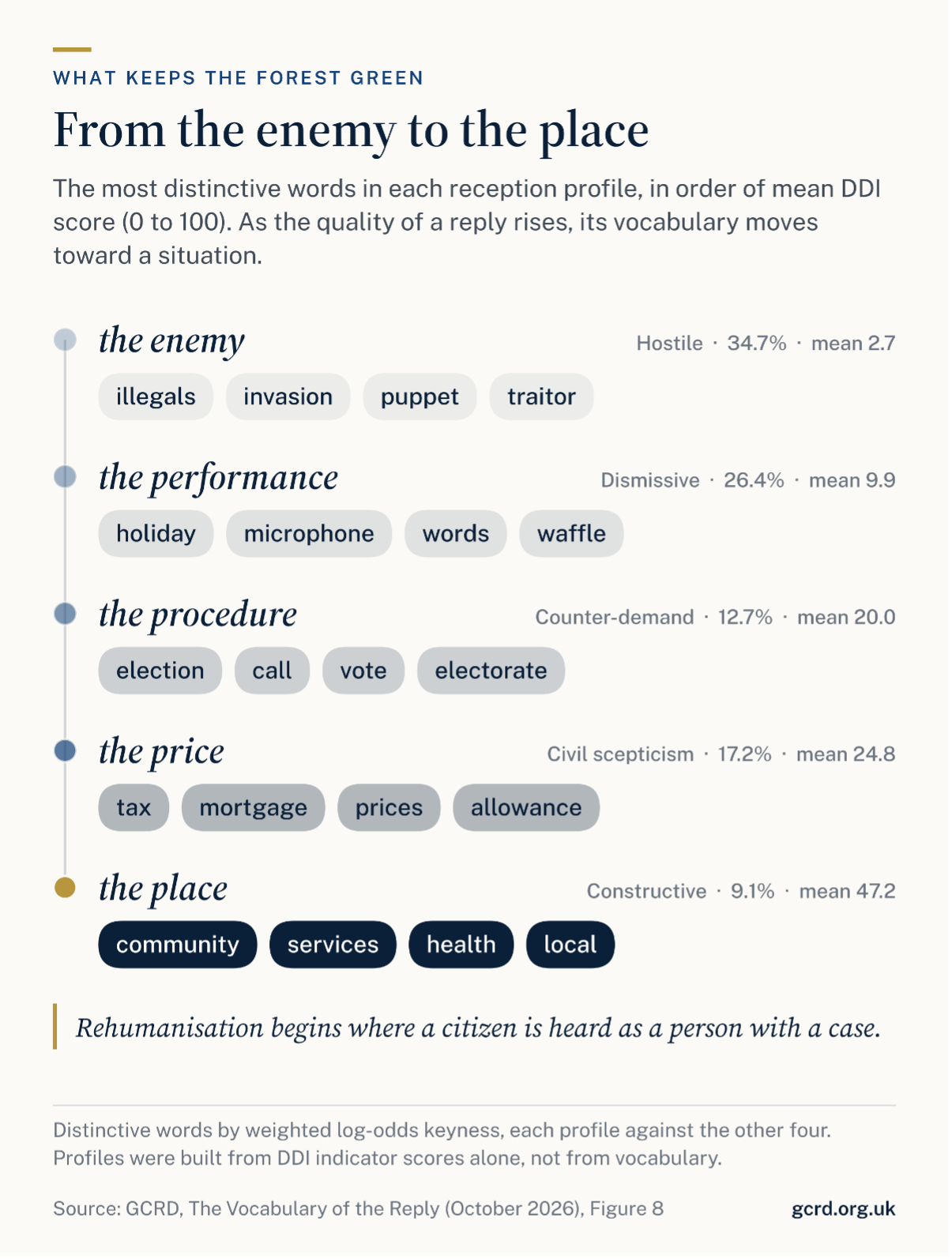
Yet the same data show where moisture remains and could potentially be generated. The best replies came from people who spoke from a specific situation, shared a vulnerability, or answered someone who had: a teacher pleading for the profession; a parent telling a worried stranger how they got their son seen sooner by contacting their MP. When citizens answered each other rather than the Prime Minister, their replies scored higher, reaching 17.3 against 14.1. And as the quality of a reply rose, its vocabulary moved from the enemy, to the performance, to the procedure, to the price, to the place.
Hope, empathy, kindness, trust and civic engagement all grow in the same soil. Years ago, in South Kivu in eastern Congo, I followed listening groups for thirteen months, each assigned to one of two UN radio programmes. One, Gutahuka, set out to persuade combatants to go home. The other, Dialogue entre Congolais, gave contending factions a platform to argue openly. Dialogue listeners spoke of "my responsibility" and "our community", expressed hope for a better future and showed more empathy for the ethnic Other. Congolese listeners of Gutahuka, by contrast, mostly came to see their Hutu neighbours as the problem.
One Dialogue listener in Walungu had begun calling in to phone-in programmes, although the calls were expensive. "If I don't do it, who would?" he said. "We can't leave it and hope that somehow those up there would know what we think."
The lesson then is consistent with the lesson now. Hope cannot be messaged into a dry forest. It grows where people take part, are recognised, find spaces to express kindness and compassion, and can see that taking part actually changes something.
How Do We Monitor the Forest Ground?
Fire services do not wait for the match. Before the season starts, they publish a reading of how dry the forest is. Democracy has no such reading.
Every serious index of democracy measures institutions: whether elections are free, whether the courts are independent and the press able to publish. There is no gainsaying their value. But they inspect the buildings at the edge of the forest. They do not feel the forest floor.
In a long drought, the trees stay standing for years. It is the undergrowth that dries first, and the undergrowth is what carries the fire. The DDI is our attempt to read the undergrowth. It scores public comments under news reports, influencers' posts and leaders' posts on twenty behavioural indicators across four conditions, each tied to a democratic function. Trust opens the communicative door. Empathy decides who is recognised through it. Civility keeps the door open during disagreement. Agency gives people a reason to walk in.
The approach is novel in one significant way: it begins in the classroom. We work with a consortium of partner universities, currently across fourteen countries. At each partner university, three trained student coders score every comment in a validation set independently, and their agreement must clear a set standard before anything proceeds. The triple-coding provides the ground truth for GCRD's ReHuman AI system to code at scale and produce national scores.
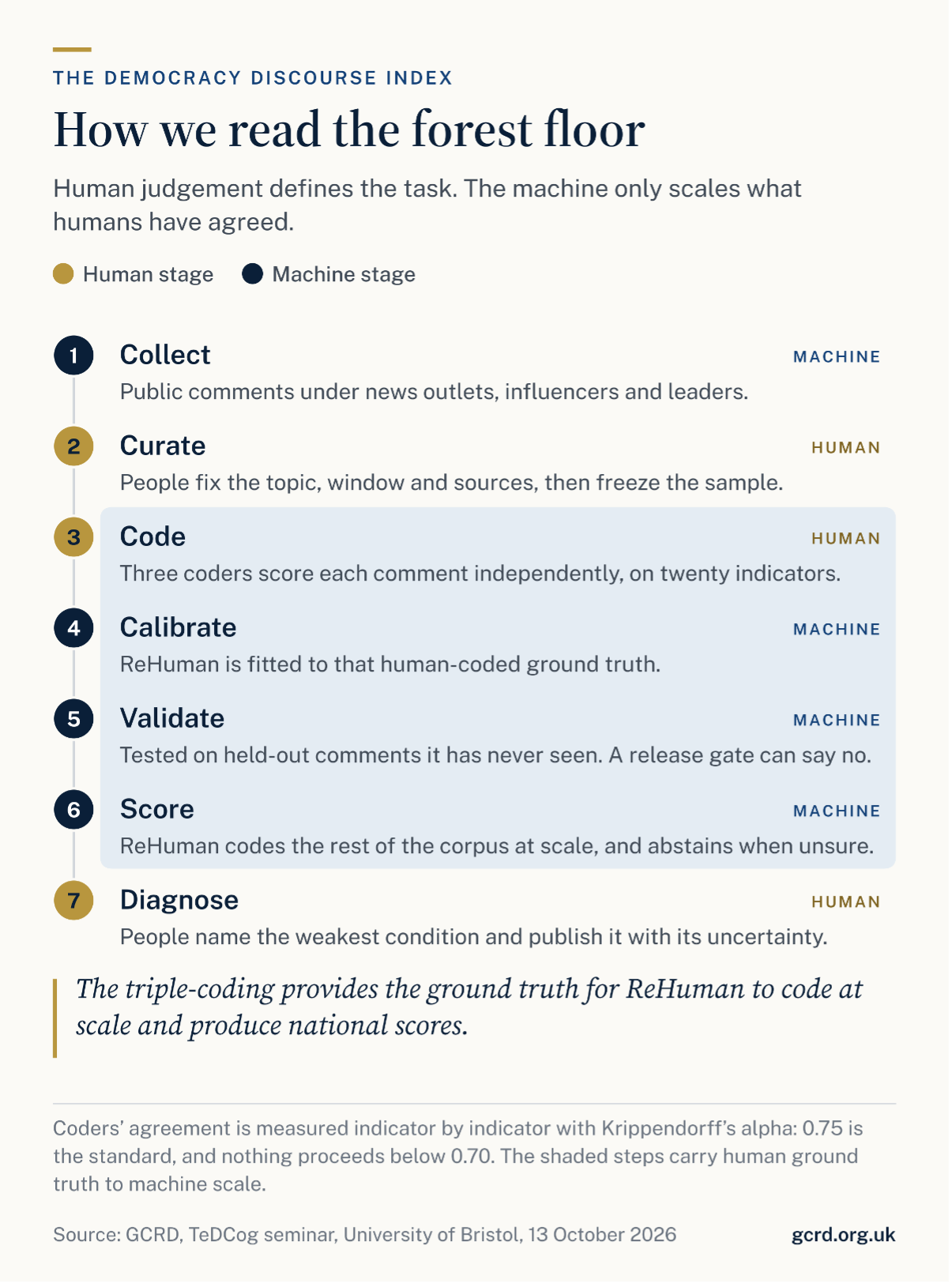
More than 250 annotators at seventeen universities in fourteen countries have made over 40,000 annotations in multiple languages. ReHuman is now validated to code at scale in the United States, the United Kingdom, Bulgaria and Pakistan. We are on track to do the same for Albania, Greece and North Macedonia before the end of the year. Our plan is to monitor globally, and in near real time, before the end of 2027.
Our Findings
The forest is not equally dry everywhere. In both hope studies, X was the driest stand, and Instagram and TikTok were markedly moister.
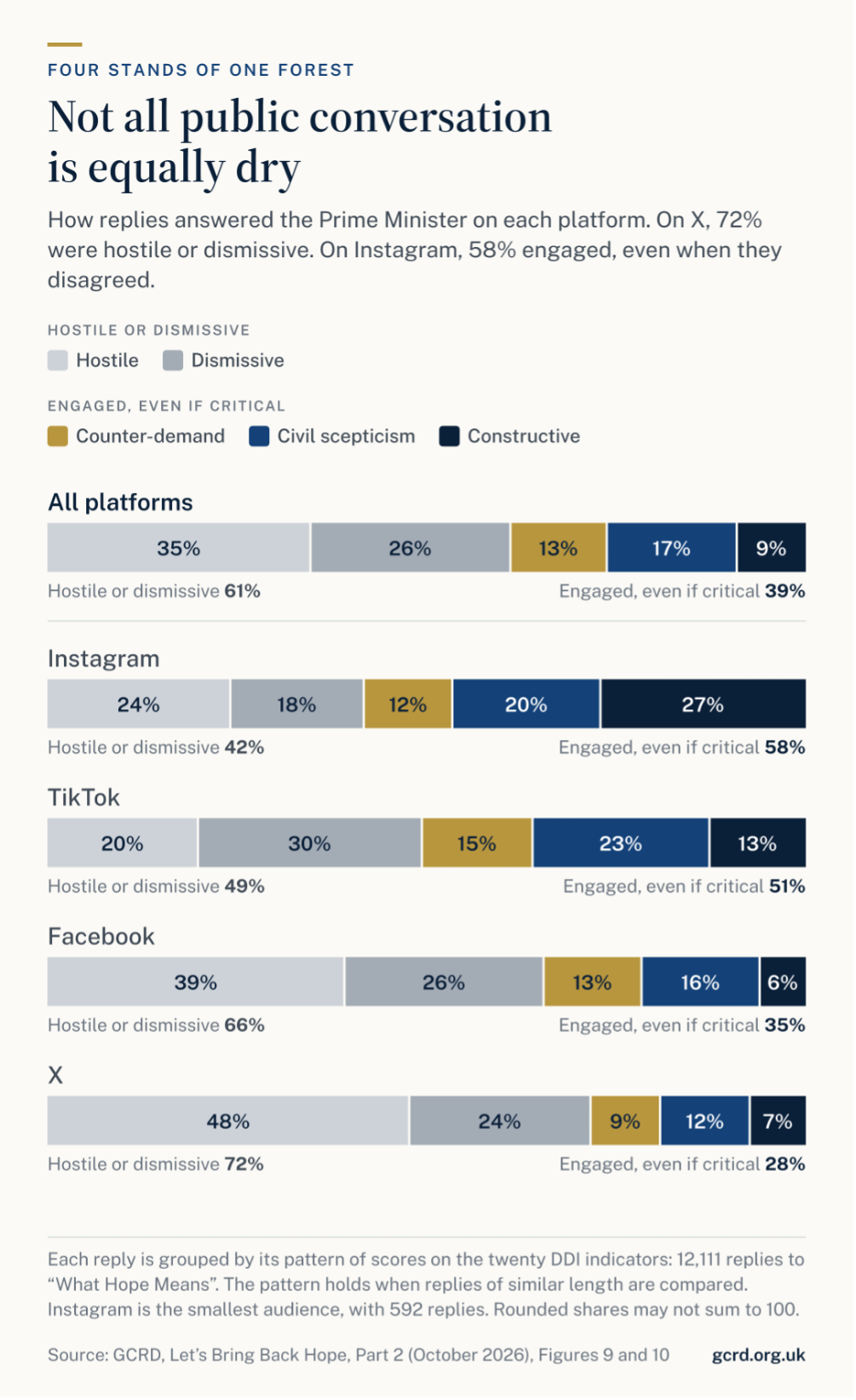
X is where journalists, policymakers and opinion leaders read the replies. The driest stand of the forest is the one where the elites stand, and from there it is easy to mistake it for the whole forest.
Nor is every subject equally dry. In replies to "What Bringing Back Hope Means", comments on immigration and borders were the driest of all, averaging 10.6 out of 100, with nine in ten in the Risk band. The political class (12.3) and Gaza, Israel and foreign policy (13.7) came next. The greenest ground lay in climate, energy and technology (24.8), public services and welfare (21.4), elections (19.0) and the cost of living (18.9).
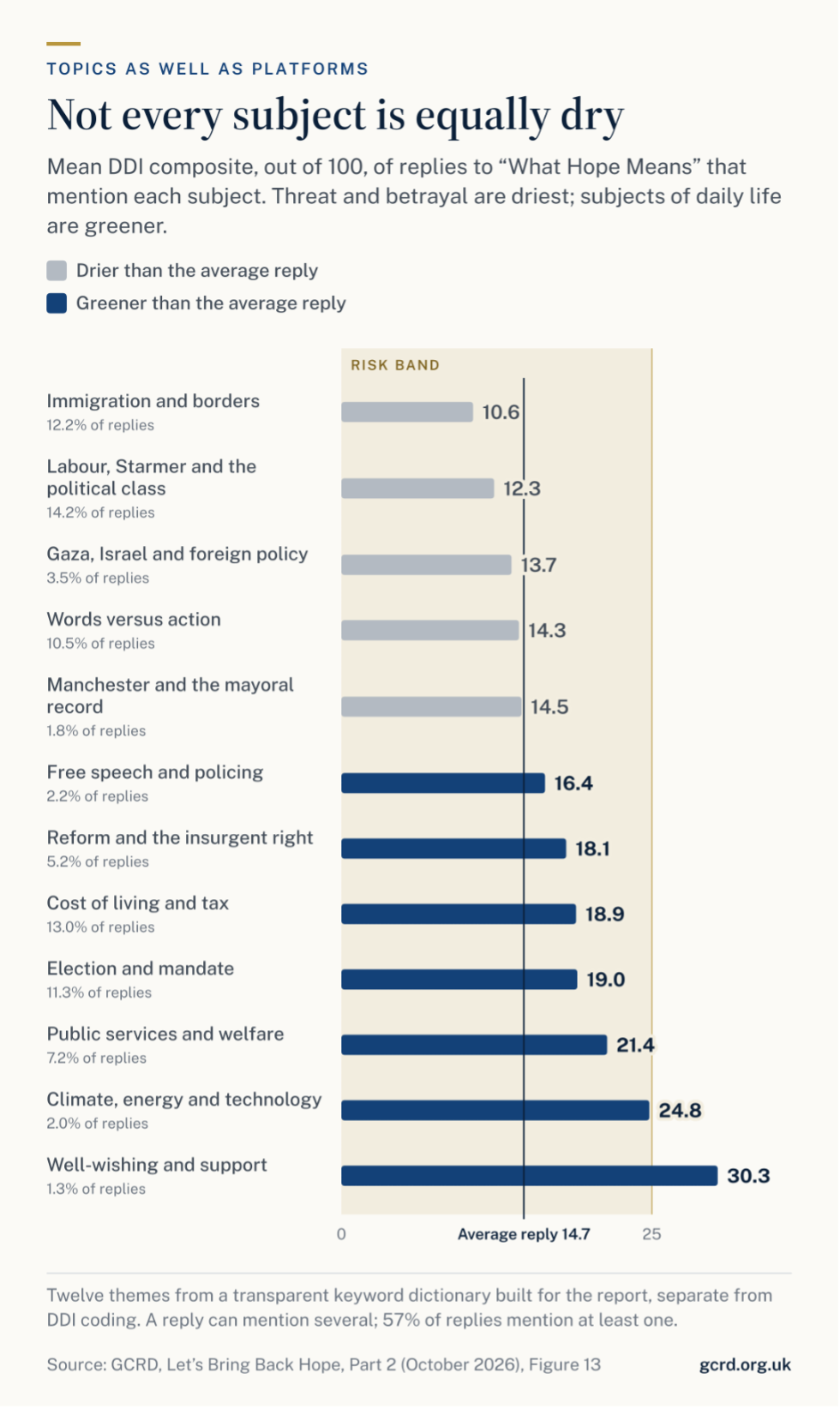
Subjects framed as threat or betrayal dry the ground; subjects grounded in lived human experience (a bill, a hospital appointment, a child's school) hold more moisture. The driest subjects are, unfortunately, also among the most discussed: borders and the political class each appear in more than 12% of replies, climate in just 2%. Topics differ beyond Britain too: in Pakistan, gender and social justice drew among the highest empathy of any topic and the lowest agency. This is why the DDI reports by topic, not only by country. A national average can hide where the tinder lies. So can a single score.
If you look at the four conditions separately, you will find that each subject is dry in its own way. Replies about public services, the cost of living and climate were above the average reply on all four. Replies about the election showed the most agency of any subject, 30% of the maximum, and almost the least empathy, 9%. Immigration, the driest subject on empathy, civility and trust, was still above average on agency. The DDI calls this mobilisation without recognition, a will to act with little regard for those on the other side, and treats it as a warning sign. Agency alone does not moisten the ground.
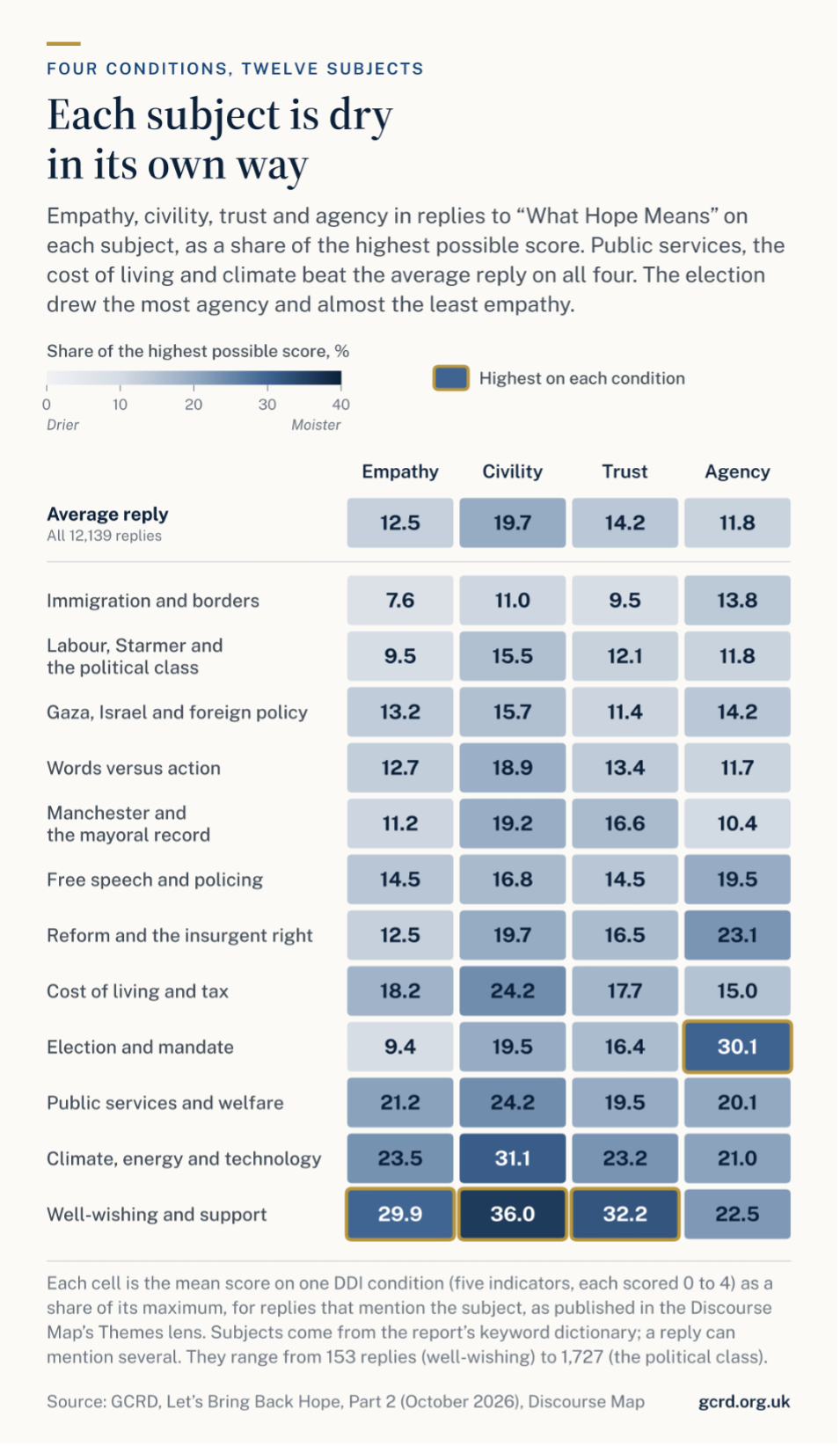
To see what each theme contains, including well-wishing and support, open the Themes tab of our interactive Discourse Map. It shows each theme's size and scores, a "Show on map" button that places its replies on the map, and, in a drop-down below the table, the keyword rule behind every theme.
Two cautions are worth mentioning. First, commenters are the stretch of forest along the roads, so our figures describe what was said in reply, not what a country thinks. But the roadside is where everyone else forms an impression of what their fellow citizens think. Second, we are aware that a map of the driest ground is as valuable to the fire service as it is to the arsonist. So the safeguards are written into the instrument itself. The DDI is not used for person-level targeting, susceptibility scoring or covert use.
What these findings say about democracy itself
Every condition the DDI measures is a relationship. Trust is a relationship with people and institutions we cannot check for ourselves. Empathy is a relationship with other human beings with whom we share a lived democratic space. Civility keeps the relationship alive even when we disagree. Agency is a relationship with the future: the belief that what we do together can change something.
More than a century ago, John Dewey wrote that "a democracy is more than a form of government; it is primarily a mode of associated living". The replies we scored show what happens when that living together begins to fray.
I had imagined that there would be a lag between the decline of discourse and the decline of democracy. Professor Stephan Lewandowsky, who leads TeDCog and invited me to give the seminar, was quick to point out in the discussion that there was indeed no lag at all. He followed up by sharing his new research (with Segun Aroyehun and David Garcia), in which they analysed 15 million speech segments from the parliaments of seven countries between 1946 and 2025. The more the speeches leaned on evidence rather than intuition, the stronger the country's deliberative democracy, as measured by V-Dem. The link shows up in the same year and runs in both directions. Discourse and democracy rise and fall together, and seem to reinforce one another. That means there is no grace period. When the conversation dries, democracy may already have dried with it!
Governments can reform electoral systems, invest in public services and regulate digital platforms, and they should. But empathy cannot be decreed, trust cannot simply be legislated into existence, and care and the human relationships that sustain democratic life cannot be restored through institutional reform alone. The democratic deficit is as much relational as it is institutional. Democratic renewal must therefore attend not only to repairing institutions but also to rehumanising our democratic commons, rebuilding the relationships that make collective life possible, and recovering a shared sense of hope in the possibility of human progress.
We certainly cannot stop every match. But together, we can keep the forest moist with empathy, hope and love for one another. That is how we can stop democracy's arsonists.
Read the Studies
• What Hope Means to the Public, Part 2
• The Discourse Map and The Vocabulary of the Reply
Originally published on LinkedIn as an article on October 17, 2026.
