

When the cognitive environment becomes a weapon, liberal arts education becomes a survival infrastructure
GCRD's three-part lecture series for AltLiberalArts is now complete. Here is what we explored, why it matters, and why the moment demanded it
Across three sessions in February 2026, GCRD Founding Executive Director Dr. Jacob delivered a lecture series titled Democracy, AI, and the Freedom to Learn: A Survival Curriculum for the 21st Century. Sponsored by AltLiberalArts, the series introduced the concept of AI-Enhanced Reflexive Control (AIRC), introduced in Jacob and Georgi Angelov (2025) and traced its implications for liberal arts education, academic freedom, and democratic resilience.
The three sessions moved from diagnosis to response. The first mapped the mechanics of AIRC: how computational content generation, predictive audience modelling, and dynamic narrative evolution combine to engineer the cognitive environment itself, producing populations who feel they are thinking freely while being steered toward predetermined conclusions. The second made the affirmative case for liberal arts education as civic infrastructure, arguing that the analytical, ethical, and contemplative capacities it cultivates are precisely what AIRC cannot automate and democracy cannot survive without. The third examined academic freedom as both a strategic target of influence operations and a foundational condition for resistance, drawing on the Bulgarian case study from research from GCRD-Sensika Disinformation Observatory.
The final session also featured a live demonstration of the Community Knowledge Encoder — a civic technology tool developed by GCRD that enables students and researchers to encode ethnographic fieldwork directly into AI system prompts on Anthropic’s Claude for the analysis of AIRC operations in their own communities. The demonstration showed how local knowledge, gathered through careful fieldwork, can become an active instrument of democratic inquiry rather than passive data.
The Community Knowledge Encoder
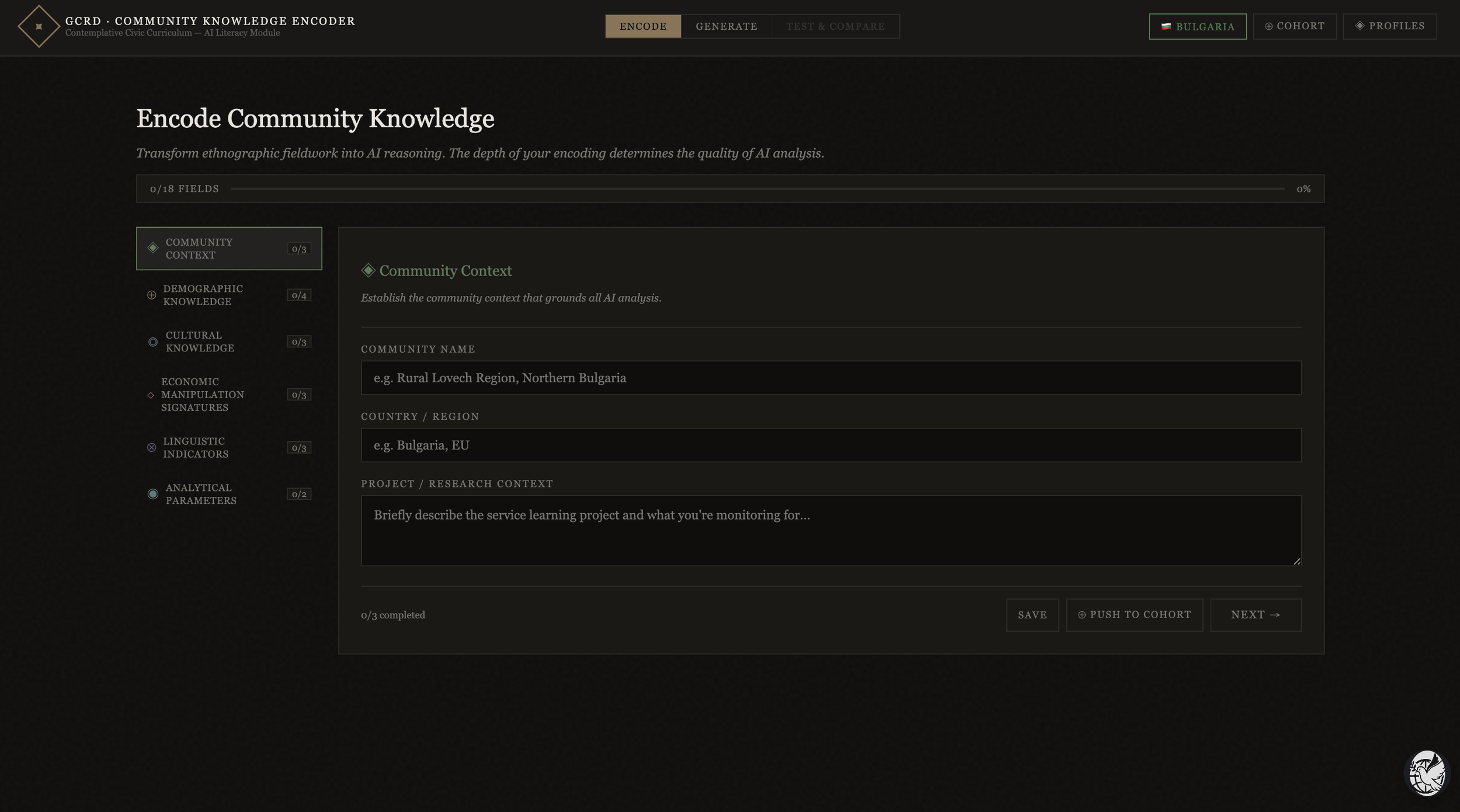
The Encoder is currently in beta mode and being trialed by selected partners. Contact us to express interest in trialing.
The Encoder matters because AIRC is not abstract. It operates through specific cultural contexts, local grievances, and community relationships. These are the very elements that generic AI tools are blind to. By allowing researchers to encode their own lived and ethnographic knowledge into the analytical frame, the Encoder shifts the balance: communities stop being objects of manipulation to be studied from outside and become agents and protagonists of their own cognitive defence.
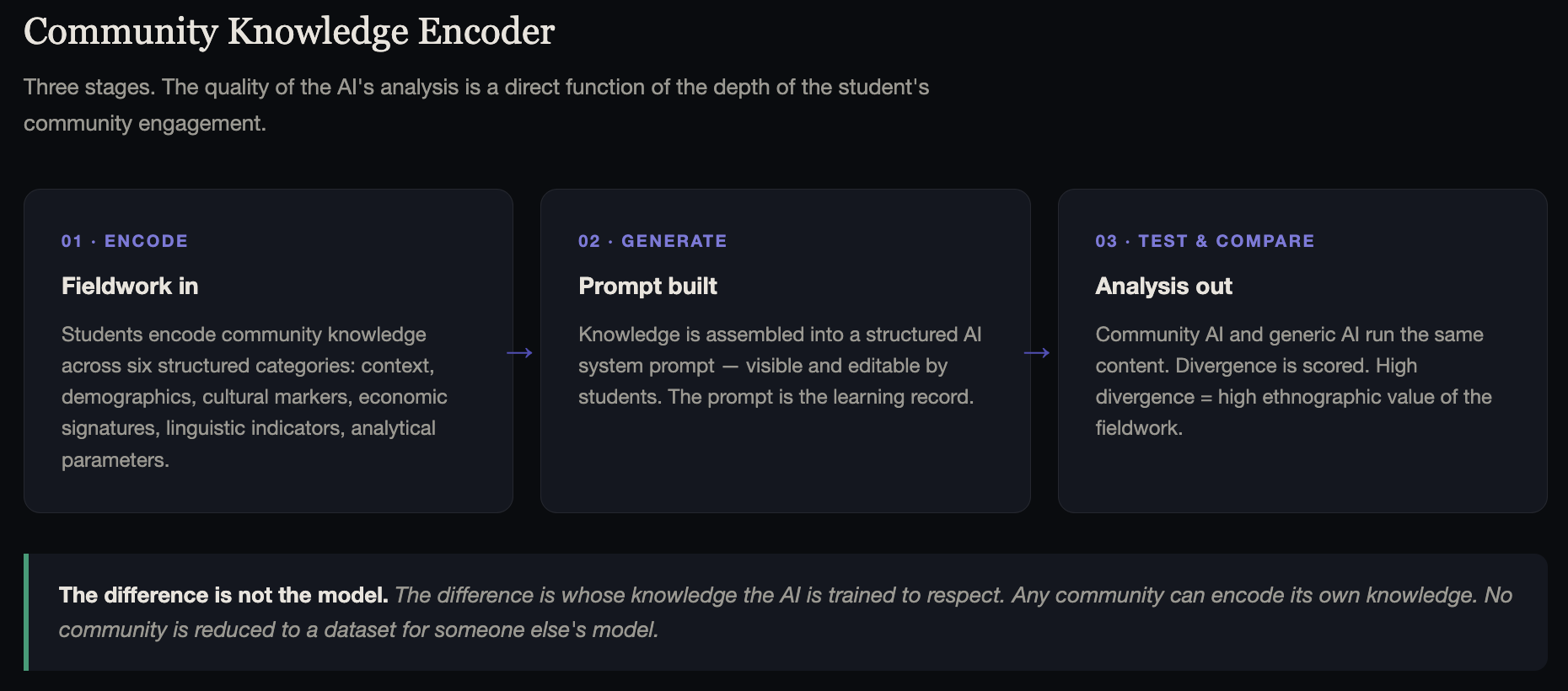
In a context where AI is deployed against democratic publics, the Encoder places AI and all its possibilities in the hands of those communities themselves.
The series reframes a question that liberal arts educators often find themselves defending on cultural or economic grounds. AIRC makes that defence obsolete, not because the cultural arguments were wrong, but because the stakes are now more immediate. When AI-enhanced influence operations can simulate consensus, manufacture social proof, and exploit the human need for belonging and meaning at scale, the interior formation of citizens is no longer peripheral to democratic politics. It is the terrain on which democratic politics is won or lost.
“The greatest danger is that we understand the problem intellectually while remaining functionally helpless. What students desperately need are practices, frameworks, and communities that make effective resistance possible.”
This is the core claim GCRD carries into every partnership: rehumanising democracy is not a slogan. It is a programme of formation — contemplative, intellectual, and civic — that builds the interior conditions democratic institutions require to function. The lecture series was one sustained argument for that programme.
The series ran alongside GCRD's launch of the Democracy Discourse Index (DDI) across seven universities in seven countries. DDI is a practical instrument for the very work the lectures theorised. The convergence was deliberate. GCRD does not separate analysis from action: the same week faculty were hearing the AIRC argument in lecture, their institutions were beginning to implement tools for tracking and responding to it in real discourse environments.
The moment is also urgent in a more straightforward sense. Spring 2026 has seen democratic backsliding accelerate across multiple contexts, AI-generated content saturate social media platforms at volumes that dwarf human output, and institutional trust continue its long decline. The cognitive environment is being engineered at a pace that outstrips most citizens' and most governments' capacity to respond. The lecture series was one part of GCRD's contribution to closing that gap.
With gratitude. GCRD thanks AltLiberalArts for hosting and championing this series, and acknowledges with appreciation the support of the Open Society Foundations and Bard College, without whose commitment this work would not have been possible. Contact us to learn more about how you can collaborate or support our work.
