

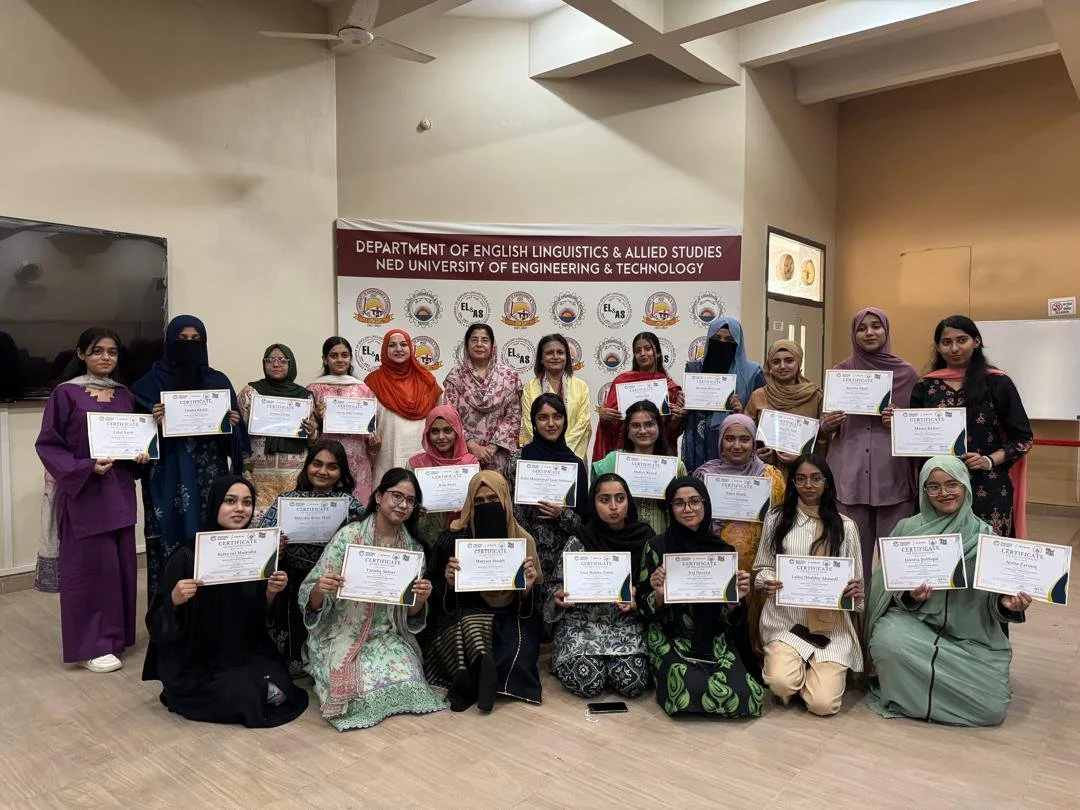
Students of NED University's Department of English Linguistics and Allied Studies celebrate the completion of the Democracy Discourse Index (DDI) Summer Internship and receive their certificates. The ceremony brought together student researchers, faculty members and GCRD collaborators, including (at the centre) Professor Dr. Sajida Zaki, Dr. Wajiha Raza Rizvi and Assistant Professor Mehwish Arif.
Karachi, Pakistan — More than 120 undergraduate students from NED University of Engineering and Technology have gained practical research experience while generating insights into the state of democratic engagement in Pakistan.
The students participated in Phase II of the Democracy Discourse Index (DDI), an initiative of the Global Centre for Rehumanising Democracy (GCRD). Working as student researchers, they triple-coded more than 8,500 social media posts and comments, contributing to a Pakistan-wide dataset of more than 12,500 human triple-coded posts and comments. The wider comparative research project currently spans 15 countries.
The students were drawn from NED University’s Department of English Linguistics and Allied Studies (DEL&AS) and Department of Electrical Engineering. Their contributions and achievements were celebrated at a recent DDI Summer Internship Awards Ceremony at NED University. The event brought together students, faculty members and representatives involved in the research collaboration.
Connecting Academic Learning with Real-World Research
For participating students, the internship provided an opportunity to move beyond theoretical learning and engage directly with the challenges of digital information, online discourse and democratic participation.
Fabiha Khan, a final-year Bachelor of Science student in DEL&AS, reflected on the knowledge, research skills and broader perspectives she and her fellow students developed through the programme. She highlighted the experience of analysing digital information, examining public discourse on important social and political issues, and understanding how research findings can inform policy.
Presenting insights from Phase II, Fabiha noted that civility emerged as the strongest dimension of Pakistan’s public discourse, while trust and, particularly, democratic agency remained the weakest. She observed that these findings point to opportunities to improve the quality of public conversations, strengthen democratic participation and build greater trust in political institutions.
Reflecting on the significance of the experience, Fabiha highlighted the value of translating academic knowledge into practical contributions to real-world challenges.
Read Fabiha Khan’s reflection on LinkedIn.
Aiman Zehra, another participating student, described how the experience had fundamentally changed the way she engages with digital information. Reflecting on six weeks of analysing online conversations, she observed: “Six weeks of scoring online posts changed how I read the internet.”
Her experience highlighted an important distinction between disagreement and disrespect, demonstrating that the quality of public discourse cannot be understood simply by examining the tone of online conversations. Context, empathy, trust and the willingness of citizens to participate meaningfully in public life also matter.
Read Aiman Zehra’s reflection on LinkedIn.
Hiba Khalid also highlighted the importance of constructive dialogue and respect for different perspectives. Through the internship, she developed practical experience in analysing online discourse and a deeper appreciation of how digital platforms influence public opinion and democratic participation. Her reflections underscore the importance of creating spaces where disagreement can coexist with mutual respect and understanding.
Read Hiba Khalid’s reflection on LinkedIn.
NED University Welcomes the GCRD Collaboration
Chairperson of DEL&AS, Professor Sajida Zaki, expressed her pleasure at the collaboration with GCRD, describing it as a valuable opportunity for NED students to apply their academic knowledge to practical research on online discourse.
She emphasised the importance of the Democracy Discourse Index and the partnership with GCRD in giving students meaningful exposure to real-world challenges through participation in a global research project. The collaboration, she noted, provides an opportunity for students to put their academic knowledge into practice and engage with issues that have direct implications for society.
GCRD’s Pakistan Principal Investigator and Senior Fellow, Dr. Wajiha Raza Rizvi, highlighted the scale and significance of the students’ contribution.
She noted that more than 120 NED undergraduate students had participated in the research, triple-coding over 8,500 posts and comments. Their work forms part of a wider Pakistan dataset of more than 12,500 human triple-coded posts and comments.
Dr. Rizvi emphasised that the DDI has connected Pakistani undergraduates with real-life social and political issues, encouraging them not only to study societal challenges but also to identify opportunities for solutions.
She further highlighted the importance of student-led research, policy briefs and recommendations in connecting the objectives of higher education with the analysis of societal challenges and the formulation of development policies. The programme demonstrates how universities can equip students with the research skills, critical thinking and practical experience needed to contribute to the development of their societies.
Advancing Rehumanising Democracy Through Education and Participation
For GCRD, the collaboration with NED University reflects a central principle of its mission of rehumanising democracy, which requires connecting knowledge with action and nurturing citizens capable of building more informed, empathetic and inclusive societies.
The Democracy Discourse Index provides a framework for examining not only what people say in public spaces but also how they engage with one another. By examining empathy, civility, trust and democratic agency, the initiative generates evidence that can inform conversations about democratic culture, institutional trust and public participation.
Involving university students directly in this research gives young people an opportunity to contribute to an international comparative project while developing the analytical and civic capacities needed to participate meaningfully in democratic life.
Speaking at the awards ceremony, GCRD Founding Executive Director, Dr. Jacob Udo-Udo Jacob, reminded participants that the democracy societies need must be grounded in empathy, hope, kindness and love for one another.
He emphasised that democratic renewal is ultimately about more than institutions and political processes; it is also about the quality of our relationships, our capacity to recognise one another’s humanity and our willingness to build societies founded on mutual respect and shared responsibility.
GCRD acknowledges the leadership of Dr. Wajiha Raza Rizvi, the support of Professor Dr. Sajida Zaki and the valuable collaboration of Assistant Professor Mehwish Arif in facilitating the partnership and supporting the students’ engagement with the initiative.
The NED University experience demonstrates the potential of university partnerships to connect academic learning with international research and meaningful civic engagement. It also affirms GCRD’s commitment to working with universities, researchers and young people to advance a more human-centred vision of democracy.
By bringing students into the heart of global democracy research, the initiative demonstrates that young people are not simply the future of democracy. They are important contributors to shaping its present and its future.
Related Social Media Posts
GCRD: Democracy Discourse Index Summer Internship Awards at NED University
Student Reflection: Fabiha Khan
