

Mediation and its Discontents: A New GCRD Policy Brief Tracks Public Discourse during Pakistan's Mediation of US-Iran War
When Pakistan stepped onto the world stage as a peacemaker, its citizens started talking differently about democracy. A new GCRD policy brief asks what that means — and whether it lasts.
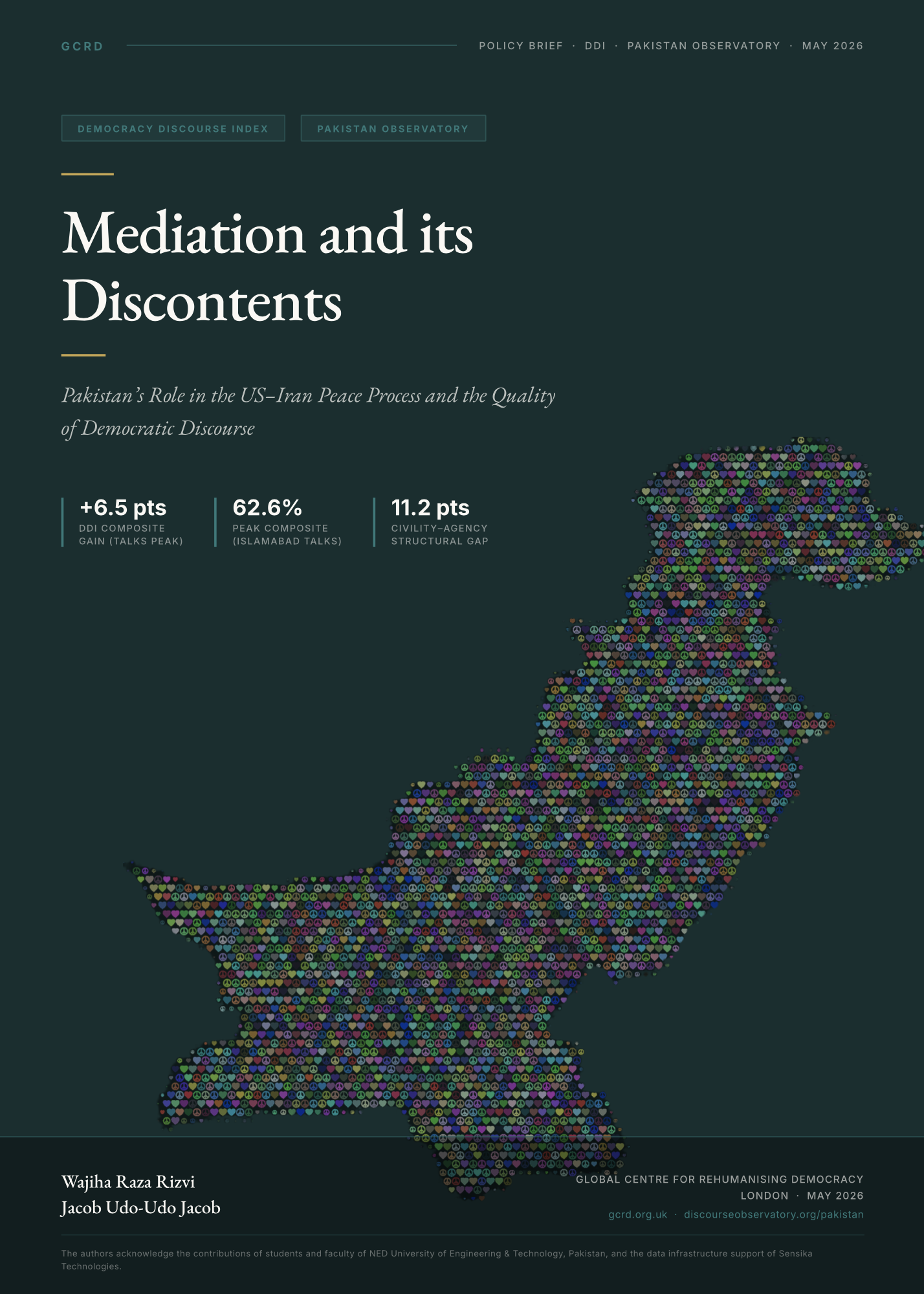
Mediation and its Discontents
Between March and May 2026, Pakistan assumed a diplomatic role without modern precedent: mediating between the United States, Iran, and their regional allies at a moment of acute international danger. Islamabad hosted a quadrilateral summit, facilitated direct US–Iran negotiations, and kept back-channel contact alive even when talks threatened to unravel. By any standard, it was Pakistan's most consequential foreign-policy moment in a decade.
It was also, it turns out, measurable — in ways that standard democracy indices cannot capture.
A new policy brief from the Global Centre for Rehumanising Democracy, co-authored with researchers at NED University of Engineering & Technology in Karachi, deployed the Democracy Discourse Index to track public conversation on X across the full seven-week arc of Pakistan's mediation. The patterns in the data are striking — and they raise questions well beyond Pakistan's borders.
What the DDI Found
The national DDI composite stood at 56.1% during the initial conflict entry period, and reached 62.6% at the peak of the Islamabad Talks of 11–16 April — a 6.5-point difference that is, in the DDI's cross-national experience, unusually large for a short window. The strongest readings came in Civility (66.9%) and Trust Language (67.9%), with more respectful registers and greater confidence in public institutions appearing alongside the period in which Pakistan was most prominently in the mediator's role.
"Pakistan's public sphere can become more civil without becoming more democratic in the participatory sense. That distinction — between surface tone and genuine civic agency — is the dataset's most important finding."
The data also point to a persistent structural pattern. Democratic Agency — the dimension that captures whether citizens see themselves as actors capable of shaping political outcomes — never crossed 56% in any batch, and averaged just 52.8% across the full study. The gap between Civility and Agency begins at 13.7 points and never fully closes. In this sample, more civil public language did not correspond to stronger participatory voice.
A Pattern Worth Watching
Two moments in the data stand out. When the hashtag #CDFGlobalPeaceMaker dominated discourse and framing shifted toward personal achievement over institutional process, Governance scores fell 5.6 points in a single batch — the steepest single-batch decline in the dataset. Separately, when the 21-hour Islamabad summit collapsed in late April, Social Cohesion fell 16 points — from a peak of 67.9% to 51.9%. The brief notes that the solidarity observed during the mediation period appeared tied to an anticipated outcome, and did not hold once that outcome was in doubt.
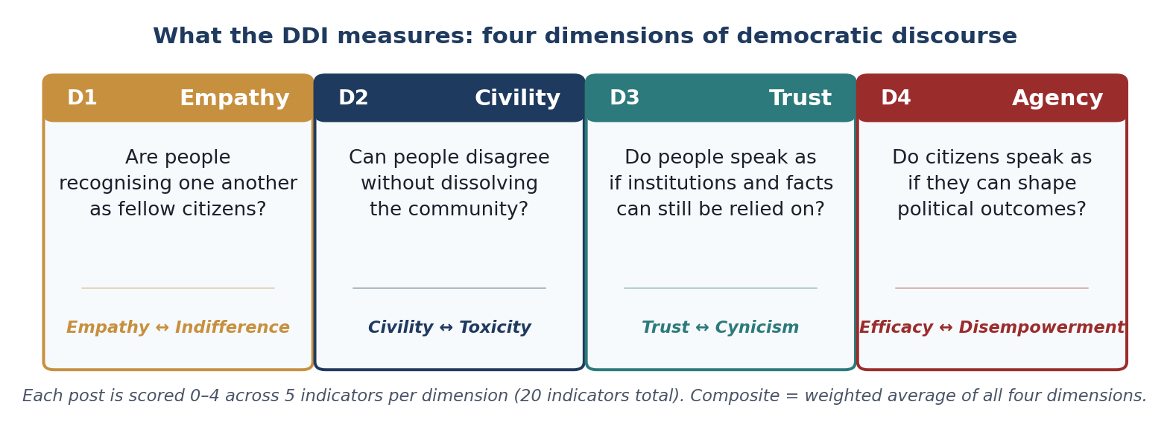
The DDI is the world’s first tracker of global empathy, civility, trust and agency in public discourse, and how they respond to national and global events.
Why the DDI Matters Now
The timing of this research matters. Across the world, democracy is under pressure — and the tools used to measure that pressure are chronically slow. Standard democracy indices like Freedom House or V-Dem are indispensable, but they measure what has already happened to institutions. They register democratic backsliding after the fact, often a year or more after the early signals appeared in public discourse.
The DDI was built precisely to fill that gap. Developed by GCRD with Sensika Technologies and a founding consortium of seven universities, it treats the quality of public conversation as democracy's vital signs — coded in near real time across dimensions of empathy, civility, trust, and agency. It is listed in the Doha Solutions Platform, the United Nations DESA repository of SDG-advancing initiatives, where it is mapped to SDG 16 on Peace, Justice and Strong Institutions.
Pakistan's pilot demonstrates what that capability looks like in practice. In seven weeks, the DDI tracked discourse patterns across a fast-moving diplomatic episode — registering shifts in civility and trust, flagging the persistent agency gap, and capturing changes in the same batches where civic-space pressures, including a disinformation campaign and a journalist's sedition charge, were also being documented. No annual index could have produced that picture in anything close to real time.
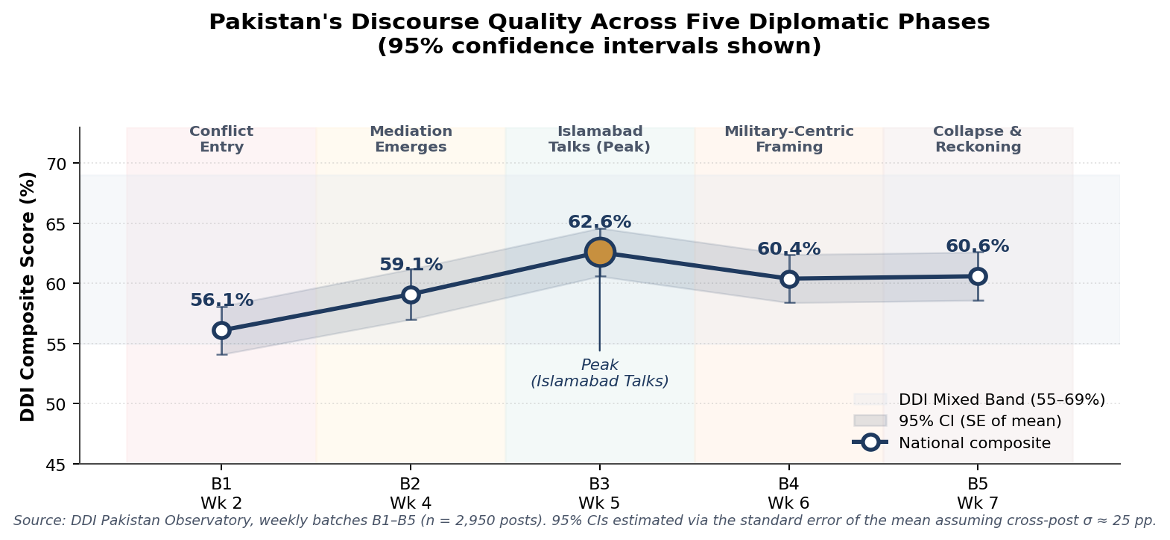
The diplomatic premium, traced week by week
Five Recommendations
The policy brief closes with five concrete recommendations for policymakers and diplomats, grounded in the patterns observed across the seven-week window.
The central argument is that durable democratic discourse requires more than favourable political moments. Civic agency needs structural support — through deliberative processes, protected civic space, and accountability frameworks that persist beyond any single episode. The DDI offers a way to track how much of that foundation is present, and where it is weakest. The full brief sets out what acting on that signal might look like.
Read the full policy brief — Mediation and its Discontents: Pakistan's Role in the US–Iran Peace Process and the Quality of Democratic Discourse and find out more about the DDI at discourseobservatory.org or at gcrd.org.uk/ddi.
