

GCRD Publishes Special Briefing on Discourse Conditions Behind Albania's Flamingo Protests
London, 8 July 2026
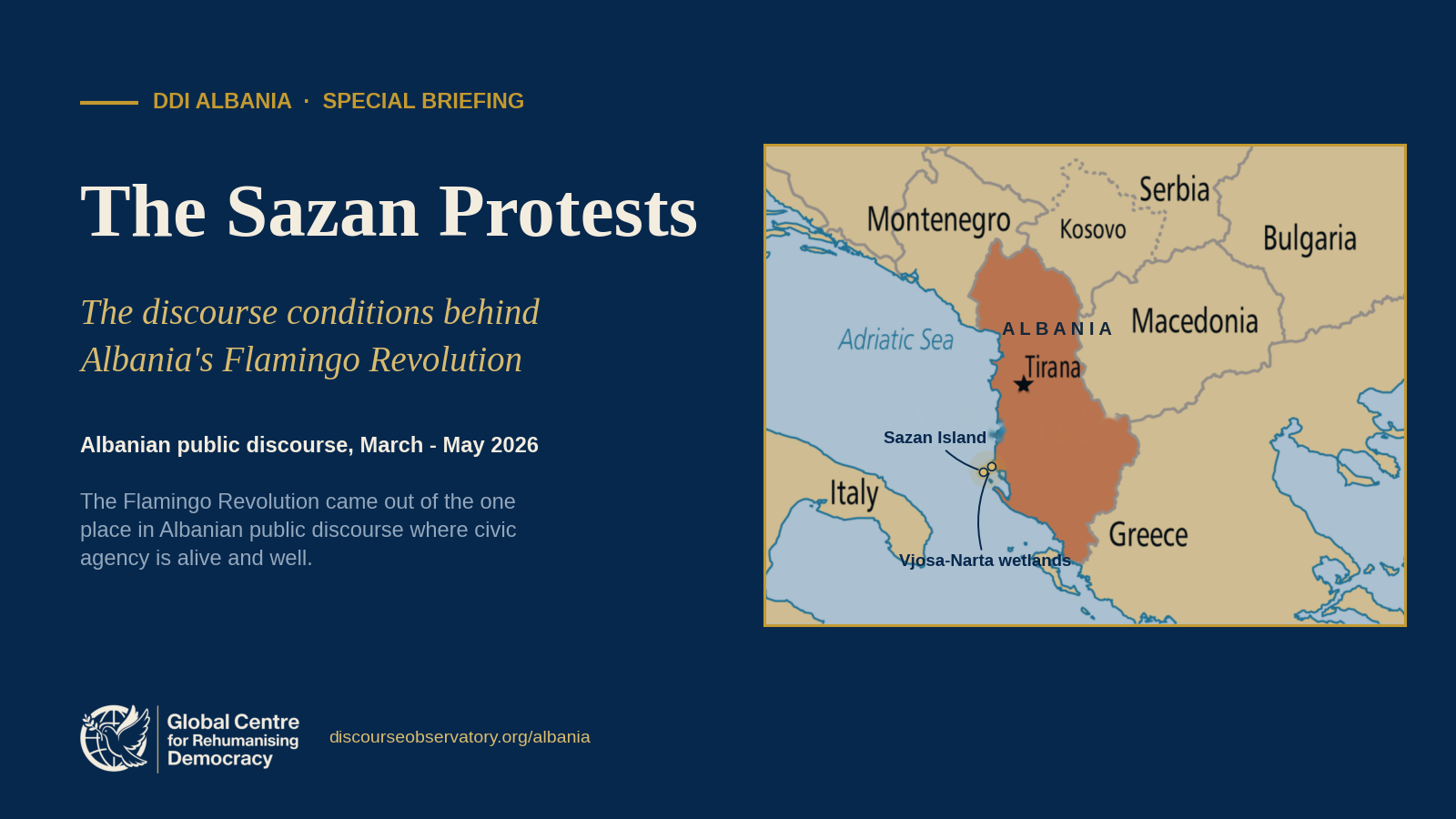
The Global Centre for Rehumanising Democracy (GCRD) has published a special briefing analysing the public discourse conditions that preceded Albania's protests over a planned luxury development on Sazan Island and the Vjosa-Narta wetlands.
The briefing, The Sazan Protests, is based on data from GCRD's Democracy Discourse Index (DDI) observatory in Albania, which analysed social media posts of Albanian public discourse between March and May 2026, in the months before the demonstrations began.
The briefing notes that Albania's national discourse quality composite stood at 41.8 percent over the period, within the index's Concerning band, while the national agency score, which measures the share of discourse in which citizens frame themselves as actors in public life rather than spectators, was 34 percent. Agency fell to 6.7 percent in discourse on social cohesion and 16 percent in discourse on international affairs.
“Sentiment analysis tells you people are angry. But the Democracy Discourse Index tells you whether citizens believe they can act, where that belief lives, and what form it will take when it surfaces. The Flamingo Revolution did not come out of nowhere. It came out of the one place in Albanian public discourse where civic agency was still alive.”
The two exceptions identified in the data were climate discourse, which scored 88.2 percent, the highest of any register in the corpus, and civic activism, which scored 56.8 percent. The briefing finds that the June protests, widely referred to as the Flamingo Revolution because the Vjosa-Narta wetlands are a major flamingo migratory route, emerged at the intersection of these two registers and have retained their characteristics, including evidence-based claims, engagement with institutions such as the Special Structure against Corruption and Organised Crime (SPAK), and non-violent mobilisation.
"Sentiment analysis tells you people are angry. But the Democracy Discourse Index tells you whether citizens believe they can act, where that belief lives, and what form it will take when it surfaces," said Dr. Jacob Udo-Udo Jacob, Founding Executive Director of GCRD. "The Flamingo Revolution did not come out of nowhere. It came out of the one place in Albanian public discourse where civic agency was still alive."
The full briefing is available at discourseobservatory.org/albania/sazan-brief.html. The live Albania dashboard is at discourseobservatory.org/albania.
Pakistan pilot featured in The Friday Times
The publication follows coverage of the DDI's work in Pakistan in The Friday Times, which on 6 July published a feature on the index and its pilot with NED University of Engineering and Technology in Karachi, led by Principal Investigator Prof. Dr. Wajiha Raza Rizvi.
Under the pilot, student researchers trained as certified discourse analysts applied the DDI in real time during the May 2026 India-Pakistan crisis. The pilot's data informed GCRD's policy brief Mediation and its Discontents, on Pakistani public discourse surrounding US-Iran mediation. The Friday Times described the DDI as "a highly effective, objective, and results-oriented model" for assessing societal dynamics in Pakistan.
About the DDI
The DDI is catalogued on the UN DESA Doha Solutions Platform as a contribution to Sustainable Development Goal 16. It measures the quality of democratic conversation, scoring public discourse on dimensions including use of evidence, civility, pluralism, and civic agency. It combines human-calibrated, AI-assisted analysis with continuous tracking through national discourse observatories and was developed by GCRD with Sensika Technologies and an international university consortium.
DDI pilot observatories currently cover Albania, Greece, the USA, Bulgaria, North Macedonia, and Pakistan. Expansion is underway to further countries, including Rwanda, Iran, Ecuador, Lebanon, the United Kingdom, and Nigeria.
For enquiries about collaboration, partnership, and subscription, contact ddi@gcrd.global.
