


A new memorandum of understanding with the Pontificia Universidad Católica del Ecuador brings Ecuadorian scholarship and classrooms to the Democracy Discourse Index.
The Global Centre for Rehumanising Democracy (GCRD) has signed a Memorandum of Understanding with the Pontificia Universidad Católica del Ecuador (PUCE) in Quito, Ecuador, opening a three-year cooperation in research, teaching and public engagement built around the Democracy Discourse Index (DDI). Signed by GCRD Executive Director Dr. Jacob Udo-Udo Jacob and PUCE Rector Dr. Carlos Ignacio Man-Ging, S.J., the agreement makes PUCE the first university in South America to implement the DDI, and Ecuador the first South American country to join its comparative study of public discourse.
Led at PUCE by the Observatorio de Comunicación (OdeCom), with an initial focus on Ecuador, the collaboration already has 54 PUCE students working on the DDI this fall semester. Through PUCE's participation in the DDI University Consortium, their analysis will carry local knowledge, linguistic fluency and country-level evidence into a comparative global effort to understand what empathy, civility, trust and democratic agency in public discourse reveal about a country’s democracy, and whether and how they shape democratic outcomes.
For Verónica Yépez-Reyes, PhD, a scholar at OdeCom and Principal Professor in PUCE's Facultad de Aprendizaje, Lenguas y Comunicación, the partnership carries forward questions about social justice and digital life that she first explored in her doctoral research, now with tools that did not exist then. She said:
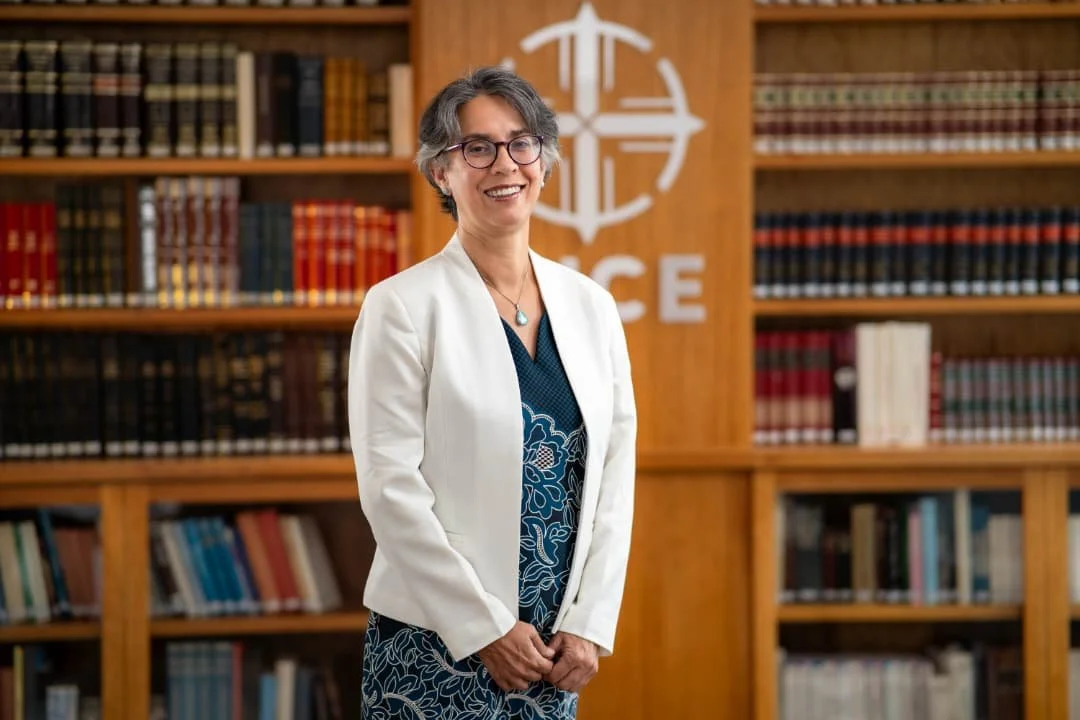
“My PhD research explored social justice in digital interactions and how collective social imaginaries are constructed through social media. The Democracy Discourse Index takes this research several steps further. What I began analysing with CAQDAS in Denmark ten years ago can now be explored through AI, while the central questions remain. I am delighted to bring these advances into my Fundamentals of Communication classroom, helping students connect communication theory with the analysis of digital discourse.”
- Professor Verónica Yépez-Reyes
Her reflection captures a continuity built into the DDI itself, in which the tools of analysis have moved from computer-assisted qualitative software to artificial intelligence while the questions about social justice and the making of collective imaginaries online, remain as pressing as ever. Student participation is accordingly anchored in a demanding research framework: each sampled item is coded independently by three trained annotators working from the DDI’s codebooks and protocols, intercoder reliability is assessed against international scholarship standards, and disagreements are resolved through faculty-led adjudication. The human coding that results, grounded in context and accountable in method, provides the contextual insight and reference material on which GCRD’s ReHuman AI analysis depends.
Under the agreement, PUCE contributes local language and contextual expertise, agreed human coding and analysis, and the necessary institutional ethics review, while GCRD provides the DDI methodology, codebooks, coder training and technical guidance, coordinates research quality and reliability assessment, and operates ReHuman AI for large scale analyses. Because both partners work from common indicator definitions and quality standards, Ecuadorian discourse can be read on its own terms, in its own languages and contexts, while remaining comparable with the evidence emerging from the DDI’s other observatories around the world.
Dr. Jacob Udo-Udo Jacob, Executive Director of GCRD, said:
“Democracy lives or withers in the everyday ways we speak to and about one another, and the Democracy Discourse Index exists to make those patterns visible, so that they can be understood, taught and repaired. In welcoming PUCE into this work we gain far more than a new research site. We gain colleagues whose scholarship on digital interaction and social imaginaries enrich our own, and young researchers who are already reading Ecuadorian public discourse with care and contextual sensitivity that no algorithm can supply by itself. It is precisely that human judgement, carefully trained and independently verified, that allows AI to serve democracy.”
Beyond the coding itself, the agreement provides for joint publications, policy briefs, workshops and public engagement, together with opportunities for PUCE to contribute to the Global Annual DDI Report and to recommend further institutions for the consortium.
Find out more about the DDI at gcrd.org.uk/ddi.
